31 - Silvana Cassar, "Tourism development in Sicily during the fascist period (1922-1943) (2009-2010)
1. index.htm
 Journal of Tourism History
ISSN: 1755-182X (Print) 1755-1838 (Online) Journal homepage: www.tandfonline.com/journals/rjth20
Tourism development in Sicily during the fascist period (1922–1943)
Silvana Cassar
To cite this article: Silvana Cassar (2009) Tourism development in Sicily during the fascist period (1922–1943), Journal of Tourism History, 1:2, 131-149, DOI: 10.1080/17551820903353447
To link to this article: https://doi.org/10.1080/17551820903353447
 Published online: 30 Nov 2009.
 Submit your article to this journal
 Article views: 684

 Citing articles: 2 View citing articles
Full Terms & Conditions of access and use can be found at https://www.tandfonline.com/action/journalInformation?journalCode=rjth20
 Journal of Tourism History
Vol. 1, No. 2, October 2009, 131−149
Tourism development in Sicily during the fascist period (1922−1943)
Silvana Cassar*
Department of Business, Cultures and Society, Universita` degli Studi di Catania, Corso Italia 55, 95129 Catania, Italy
(Received 17 July 2008; final version received 6 July 2009)
This article provides a case study of the development of tourism in Sicily during the first four decades of the twentieth century. It assesses the attempts of regional and national government, especially during the fascist period, to promote tourism through the provision of elite services and attractions and the development of infrastructure, and tries to explain the limited extent of their success. These initiatives are set in the comparative context of developments elsewhere in Italy during this period, and the findings of this article can usefully be compared with the development of tourism under other contemporary authoritarian regimes in Europe, especially Germany under the Nazis and Spain under Primo de Rivera. The Sicilian situation is also compared with spatial and temporal trends on national and international scales.
Keywords: tourists; Fascism; Italy; promotion; hospitality; transport; events
Regional tourism bodies in the early decades of the twentieth century
Sicily has a much less established tradition of tourism than Northern Italy, a consequence of the fact that it only became part of the usual destinations of the Grand Tour from the 1770s onwards, of the relative difficulty of travelling to it and within it, and of very limited infrastructure (Black, 2003; De Seta, 2001). Initially, only a handful of places located along the coast or inland received attention from travellers (Battilani, 2001, pp. 269−270). Generally, places in the interior of the island were, a priori, excluded from tourist itineraries, due to the inadequate road system that made reaching them difficult (Balsamo, 1809; Guerra, 1784; Scrofani, 1791) and due to the lack of initiatives that would have helped to develop the local situation.
The first stage in the take-off of tourism in Sicily started with a clear trend towards elite tourism (about Italian tourist development in the nineteenth century, see Dawes, 2003) which was concentrated in Taormina, where the transformation from lively farming town to prestigious tourist destination had begun, between the late nineteenth and early twentieth centuries, with the completion of the Messina− Catania railway and the construction of a number of very fine hotels (for further details, see Restifo, 1996, 2000). In the first decades of the twentieth century, a new boost to international elite tourism came from the annual motor race known as the Targa Florio, which had its circuit in the Madonie Mountains and was held in spring. The Targa was founded by Vincenzo Florio, who was fond of motor races,
*Email: scassar@unict.it
ISSN 1755-182X print/ISSN 1755-1838 online
Ⓒ 2009 Taylor & Francis
DOI: 10.1080/17551820903353447
but also aware of the great appeal that such events could have to European high society. Florio also promoted the institution of the Panormitan Committee, which controlled the organization of this important sporting event and the related entertainment and tourism activities (Garc`ıa, 1986, pp. 29−32, 81).
When the extension of the race circuit and the inauguration of the Giro di Sicilia were decided, Florio urged the necessity of founding a regional motor institution recognized by the national Automobile Club (Canestrini, 1966, p. 92). On 21 December 1913, the Automobile Club di Sicilia (ACS) was founded, with Florio as president. The ACS set up the Primavera Siciliana (Sicilian Spring) Committee, which took the tasks over from the Panormitan Committee and would go on to play a role of considerable importance in promoting tourism in the island (Bradley, 1965, p. 33; Garc`ıa, 1986, p. 120, 126).
Well-off tourists who were attracted by this important event were lodged in new hotels in the Mondello area (Canestrini, 1966, p. 139; Giannico, 2007, p. 48) or in luxurious hotels such as the Villa Igea in Palermo (built by Ignazio Florio), or the San Domenico in Taormina. They were encouraged to extend their stay on the island by the increasingly widespread organization of a range of tourist itineraries connected, in some way, with cultural events and leisure activities. The Primavera Siciliana Committee offered, to tourists who came to follow the motor race, the possibility of travelling round the island at reduced rates in order to see a range of different events, such as horse races, tennis tournaments, performances of opera and plays from the classical repertory in the Ancient Greek theatre in Syracuse. The Committee became very well-known abroad because of the system of cut-price travel enjoyed by the foreigners who poured into the island in the spring to follow the motor races (see, for example, Automobile Club Sicilia [ACS], 1929, p. 2; Paternostro, 1946b, p. 22; Touring Club Italiano [TCI], 1930, p. 221, 1932, pp. 447−449).
The Committee’s work was brought to an abrupt halt by the outbreak of the First World War, and in the post-war years its work was limited almost exclusively to the Targa Florio motor race and the offer of reduced rail fares (Paternostro, 1946a, p. 16). However, its work took off in 1923 due to three simultaneous favourable develop-ments: funds set up by the government for works in the Madonie circuit; further reductions in the costs of rail fares; and introduction of Napoli−Palermo daily trips on Florio’s elegant ships. Furthermore, in 1923, even the fire that destroyed the wooden facilities of the Madonie circuit was turned to account: the boxes, structures and grandstands were rebuilt very quickly and with enhanced elegance, functionality and safety, generating the new ‘Floriopoli’, officially inaugurated on 27 April 1924. In that year, 12,000 tourists, half of whom came from abroad, poured into Palermo. This represented the first indication of a resumption of elite foreign tourism, which had been brought to a halt in the previous decade (Canestrini, 1966, pp. 138−139, 168).
Towards the middle of the 1920s, the resumption was still temporally and spatially limited. The tourism sector was still struggling to recover after the war. Against such a background, the initiative taken by the then director of the Banco di Sicilia and senior Fascist Party member, Ignazio Mormino, in 1926 seems very enterprising. Mormino was responsible for setting up the Associazione per lo Sviluppo del Turismo in Sicilia (ASTIS, 1926: the Association for the Development of Tourism in Sicily) − Association for the Development of Tourism in Sicily.
The Association was founded in partnership with the Banco di Sicilia, the Fondazione per l’Incremento Culturale ed Economico della Sicilia, as well as
Touring Club Italiano, Automobile Club d’Italia, ACS, Club Alpino Italiano and ENIT, the Ente Nazionale Industrie Turistiche (Paternostro, 1946b, p. 16; Policastro, 1928g, pp. 41−50; for the Touring Club Italiano, see Bosworth, 1997, pp. 371−410). As the director of the Banco di Sicilia was also entitled to be president of the new body, Ignazio Mormino was the first to fulfil this role. The vice presidency was given to Vincenzo Florio, president of the ACS, while the presidents of the other founding institutions acted as statutory board members. The Fondazione per l’Incremento Culturale ed Economico della Sicilia was represented by Emirico Vismara, a leading figure from the Societa` Generale Elettrica della Sicilia. Vismara would prove to be particularly committed to the island’s development. General management of the body was entrusted to Giuseppe Paternostro, who had developed considerable experience in the tourism industry through his long stays abroad.1
The undertaking received full approval from Mussolini himself, and indeed the Duce became the first name on the membership list. The fascist regime displayed great interest in promoting tourism all over Italian territory, not only for economic purposes but also for propagandizing its policy by winning the influential support of favourably impressed foreign visitors (see, for example, Berrino, 2007, p. 82; Darioski, 1929, pp. 50−52; Menicucci, 1928, pp. 30−32; Senio, 1929, pp. 26−27; Syrja¨maa, 2007, pp. 344−357). This is why, in the fascist period, Italy saw significant enrichment and refinement of the official tourism organization, which had started in 1919 with the ENIT Constitutive Law. Law no. 1381 of 1 July 1926 set up the so-called Aziende autonome di Cura, Soggiorno e Turismo (CST), independent tourism boards that also covered health resorts,2 nine years before the birth of provincial tourism institutions. The task of these Aziende was to work in the most important tourist centres (Berrino, 2005, pp. 34−37; Paloscia, 1994, pp. 47−50, 2004, pp. 39−50), while the Pro Loco, or tourism offices, present in the minor tourist centres, were organized as private, free-standing associations. ENIT lavished growing efforts on improving the reliability of the collection and elaboration of the statistical data and on the hotel classification, on the basis of parameters related to the quality of service and recognized all over Italy (ENIT, 1926, p. 55). ENIT also increased the production of tourist propaganda material − between 1921 and 1925, the amount of printed pages issued rose from 890,000 to 10,994,000 (ENIT, 1926, p. 14; Syrja¨maa, 1997). The intensification of the dictatorial aspects of the fascist regime spurred on the development of external propaganda. In the inter-war period, like other contemporary authoritarian regimes in Europe3, fascist regimes viewed tourism as a means to advance their ideological agenda (Semmens, 2005a, p. 145), taking the ‘problem of pleasure’ very seriously (Jameson, 1983, pp. 1−12). The nationalist and imperialist aims in the fascist dictatorship were, however, less powerfully expressed than in Nazi Germany, where tourism had very strong racist aims and ‘was used both to celebrate the Nazis’ ‘‘achievements’’ and obscure the horrors of a murderous regime’ (Semmens, 2005a, p. 159). Furthermore, the Italian interest in tourism was not only due to political but also economic reasons. In the inter-war period, new tourist trends and fashions also spurred investment in other parts of Europe (see, for example, O’Neill, 2005, pp. 228−244; Peniston-Bird, 2005, pp. 162−178; Walton, 2005, pp. 179−194).
Whereas ENIT worked on a national scale, the Aziende di CST and the Pro Loco
worked within their own reasonably wide spheres of influence. In this context, ASTIS was to become the official organ of ENIT in Sicily as its regional representative, with
many tasks such as tourist propaganda; coordination of the tourist centres of the island; vigilance over associated hotels guaranteeing quality of service, and mediation in credit transactions with the Banco di Sicilia (ASTIS, 1929a, p. 4). The setting up of such a regional tourist institution, recognized on a national scale as part of the ENIT, represented a peculiarity in Italy. But it was also the answer to the particular needs of Sicily, where tourist traffic had regional features both for geographical reasons and the presence of many tourist attractions that needed to be linked to accommodation and communication services (Associazione per lo Sviluppo Economico del Mezzo-giorno e per il Turismo [ASEMT], 1933, p. 112; Paternostro, 1946b, p. 18).
The ASTIS set up a special committee to carry out a survey assessing levels of accommodation in the hotels, restaurants and inns located along the tourism routes. Formed by the general secretary of the Association, by an executive official from ENIT and an expert from the hotel sector, the committee uncovered the limited quality of Sicily’s range of hotels. The survey returned a verdict of ‘rather unsatisfactory’ for the smaller towns where visits were usually no more than unavoidable halts to rest or overnight stays. The same conclusion was reached for a number of other areas which displayed considerable tourism potential.
ASTIS also earned considerable acclaim and a reputation for reliability in terms of the welcome and accommodation offered to tourists due to its constant vigilance over associated hotels guaranteeing quality of service (Policastro, 1928g, p. 45). In hotel accommodations, ASTIS represented ENIT in Sicily by exercising vigilance concerning hygienic and sanitary measures and the control of prices, which had to be in accordance with the quality of service (Mariotti, 1923, pp. 65−66; TCI, 1925a, pp. 199−201, 1925b, pp. 197−199).
In the space of a year, the technical suggestions, practical advice and promises of grants to reward positive responses to suggestions by the committee produced a number of significant improvements, which the committee documented in a detailed report published in the periodical Vie d’Italia.4 Thus, thanks in large part to the workof ASTIS, the level of quality, comfort and accommodation in the hotels −however small − in the minor towns and lesser-known areas on Sicily’s grand archaeological and tourist circuit, such as Castelvetrano, Sciacca, Castrogiovanni and Tindari, showed improve-ment. In other places, such as Caltagirone and Petralia, where travellers often stopped simply to eat or rest, the committee’s work led to a drive to raise the profile of those restaurants which were already of reasonably good quality (Senio, 1929, p. 27).
In a number of places endowed with particular appeal for tourists, ASTIS managed to spur the opening of new restaurants. The Association transformed the Casa dei Viaggiatori (Figure 1), located near the Castello Eurialo archaeological site, Syracuse, into one of the most sought-after destinations for foreign visitors, as it was also connected to the city centre by decent roads. At Segesta, another site which drew a great many Italian and foreign visitors, the Association built an elegant chalet (Figure 2) which offered travellers the perfect place to enjoy a comfortable and pleasant stop in a stunning setting which blended the beauty of nature with the enchanting remains of ancient civilizations.
Apart from studying solutions to the deficiencies in the hotel accommodation and restaurant services offered to tourists, from the very start it was part of ASTIS’s mission to investigate a range of more serious obstacles to the full development of tourism in Sicily, first and foremost, the problems related to the island’s transport
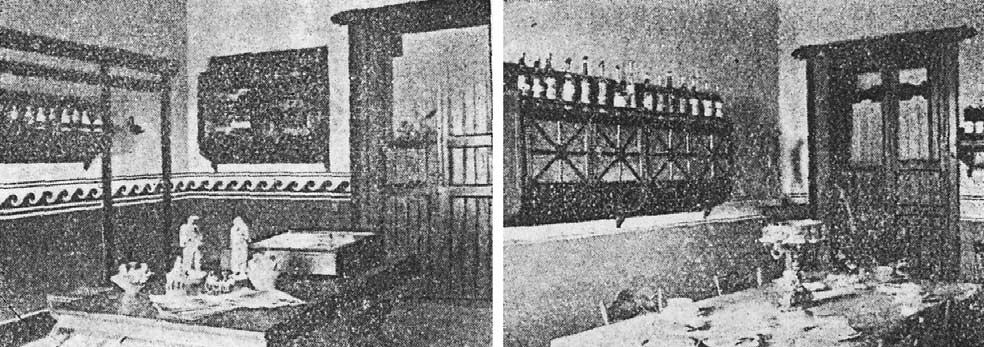
Figure 1. Casa dei Viaggiatori.
system (Paternostro, 1929a). Solving these problems would have given a significant boost to the island’s economy (Paternostro, 1929b, pp. 1−3).
ASTIS began to tackle the problem by dealing with the signposting on the Palermo−Trapani road, and then extending the service to other areas which requested it. Clearly, the Association was not able to intervene in such a direct manner to improve the conditions of the road network per se. In an effort to assess tourism potential the director of the Association, Giuseppe Paternostro, ordered a thorough investigation and put forward a number of proposals, based on a realistic vision of just how much support or financing could be obtained from the State, and insisting that his proposals be put into action whenever the roads to be improved involved areas of major interest for tourism.5
ASTIS saw the resolution of road-related problems as one of the Association’s priority objectives, as Sicily neither had a sufficiently extensive railway network, nor was any further extension planned. In reality, there was a lack of real facilities to support the creation of tourist routes. For the most part, tourists travelled from one area to another by road, often using hired cars. Given that it would have been far-fetched to envisage switching to a more efficient alternative mode of transport in the short term, ASTIS worked towards containing, in part, the cost of car hire which was effectively too high for middle-class tourists.
Thanks to the efforts of ASTIS, between 1927 and 1928 limousine services were set up which, while maintaining the allure of luxury services, allowed travellers to pay for individual places. These luxury car routes followed fixed itineraries covering long
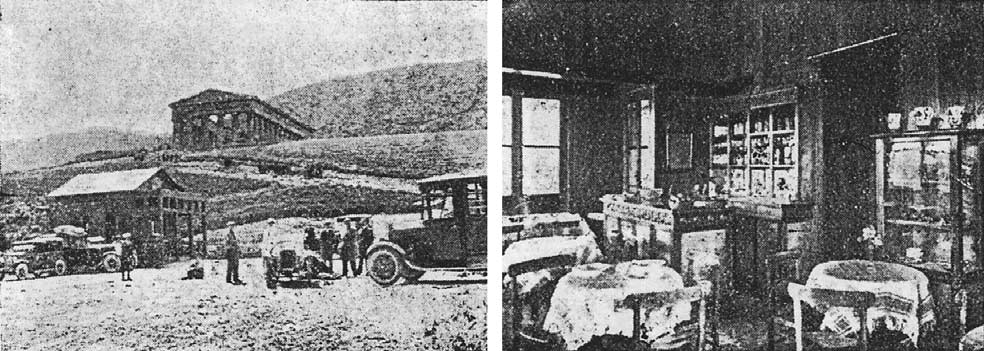
Figure 2. Chalet, Segesta.
and, for the most part, complete stretches of road and were just as punctual as the best railway lines. Travellers greatly appreciated the service and this boosted the sale of ASTIS tickets through travel agents − like Cook, CIT, Wagons-Lits, American Express and so on − (Azienda Provinciale Turismo di Catania [APTC], 2001, pp. 114−115) not only in Italy but also in major European cities, Paris, London, Amsterdam, Lie´ges, Berlin and even in the USA and Egypt (ASTIS, 1929a, p. 4). Therefore, every year travel agencies sold several hundreds of ASTIS tickets in addition to several thousands of reduced-rate rail tickets.6
In the early years, the service offered by ASTIS was still at an experimental stage (ASTIS, 1929b). In 1929, some eight-seater limousines, equipped with comfortable armchairs were added to the initially used first-rate five-seater tour cars. The total number of tourists using the system rose from 283 in 1927 to 372 in 1928 and 721 in 1929. At first sight, the numbers would seem modest, but ASTIS’s car services were expensive and generated substantial multiplier effects, besides being concentrated into the three months of the Primavera Siciliana entertainments. Furthermore, ASTIS’s car services lasted several days, whereas most tourist services in the rest of Italy had shorter durations (usually one day or a few hours) and included several trips every day.
The efficient management of those car services was used for political propa-ganda, for example, in 1929 for the so-called ‘Ottobrata Siciliana’, organized by ASTIS and ENIT to point out the stimulus given by Fascism to the Sicilian economy. On this occasion, a complete tour of Sicily, including historical, archaeological and natural sites, as well as modern and industrial centres, was planned for the 28 foreign and 15 Italian reporters, guided by the government press office delegate (ENIT, 1930, pp. 48−49).
In 1930, the Macera Garage of Palermo, which had been one of ASTIS’s faithful collaborators, took its place in the management of regular car services on the Sicilian Grand Tour. In the same year, the Garage fleet of cars was enriched with a first-rate 18-seater coach, with very comfortable armchairs. Thus, all in, the Garage had 87 armchair seats at its disposal and about 26 seven-seater cars. The annual passenger total grew from 721 in 1929 to 794 in 1930, 753 in 1931 and 893 in 1932; in the same year, the distance travelled in kilometres grew from 57,662 to 64,770. Meanwhile, road conditions improved and ticket costs fell by at least 50% from 1927 to 1933. These car services kept more than 20 tourist centres within easy reach. Sicilian Grand Tour was the most important car service organization in Southern Italy and at the same time a unique example all over Italy since there were no other Grand Tour companies that made regular trips of up to nine days even four times a week (ASEMT, 1933, pp. 113−119).
No information about the Sicilian Grand Tour after 1933 is available, but the strong seasonal links existing between this organization and the Targa Florio event, along with the related entertainments, suggest that this year marked the beginning of its inexorable decline. In 1933, Targa Florio was turned by the government into a bureaucratic product and only a few modest editions of the event followed. The definitive sign of decline was in 1937, when the race was moved from the Madonie circuit to the Parco della Favorita circuit, which had a level and shorter track. Vincenzo Florio became embittered and resigned from his role of ACS president, while the subsequent Targa Florio races lost most of their international appeal, causing a significant reduction in the related foreign tourist traffic (Bradley, 1965, p. 166; Garc`ıa, 1986, pp. 243−244, 246).
Eliminating ASTIS
In 1934, officials from the General Commission on Tourism, with a mandate for the state control of tourism in the regions, came to the not unreasonable conclusion that it would be better to have just one regional tourism body in Sicily. But they decided to eliminate ASTIS, despite the Association’s strong financial health and its superior planning capabilities, while preferring to bolster the economically failing Primavera Siciliana Committee, which had gained a higher profile abroad, thanks to its offer of reduced travelling fares.
Following an overhaul of its statutes and radical changes in management, the Committee was officially recognized as the only regional tourism body in Sicily, but the lack of internal cohesion and the failure to grasp the legitimate aspirations of some of the island’s tourism areas soon plunged the body into an intractable crisis. The government was quick to intervene, dismissing the board members and dispatching an ‘extraordinary commissioner’ with the precise, albeit officially unacknowledged, task of winding up the body. The Committee’s regional role irked those who held that the provincial tourism bodies should be the only peripheral executive representatives of the institution that had created them, namely, the General Directorate for Tourism.
Despite the instructions which came with his role, the commissioner reported that if the Primavera Siciliana Committee had not already been founded, it would have been necessary to set it up and that, far from being eliminated, the committee was to be reinforced in economic terms − this was certainly the case when the Committee received the total income from the sale of passes to claim reductions on rail, plane and maritime travel. The commissioner went as far as to declare that, as part of a general reorganization of the tourism system in Sicily, the Committee should be given greater regional scope as coordinator for the other, smaller, tourism bodies (Paternostro, 1946b, pp. 16−17).
In 1935, every province in Italy saw the creation of the Enti Provinciali di Turismo, the provincial tourism boards responsible for coordinating the work, at provincial level, of the various organizations and bodies involved in promoting tourism traffic, studying problems related to tourism, making proposals and suggestions regarding tourism issues and carrying out the various tasks assigned to it by the Ministry of Popular Culture − General Directorate for Tourism. The truth of the matter is that it would not have been misplaced to judge the work of these provincial bodies as ‘a palpable and useless duplication of the activity which the law require[d] of the autonomous agencies’ (Paternostro, 1946b, p. 18). They were costly to maintain, financed by compulsory contributions from municipalities, provincial economic councils − required to bear some of the cost of renting premises as well as running costs − together with a percentage levied on the revenues assigned to the tourism boards, and finally by a tourist tax on private individuals collected through the public tax offices by way of a rather complex, and consequently costly, bureaucratic procedure which in the end weighed very heavily upon the bodies’ own budgets.
In brief, during the 1930s, the tourism ‘system’ in Sicily was spread over one
regional board, the Primavera Siciliana Committee, nine provincial tourism boards (one for each province), five autonomous agencies in Palermo, Syracuse, Taormina, Acireale and Sciacca, and a number of municipal bodies and a multitude of Pro Loco. This hodgepodge of bodies, with no real distinction in responsibilities and
mandates, led to overlapping tasks as well as reciprocal interdependence and interference, with consequent waste of energy and money that only added to the waste of resources by local bodies on jingoistic undertakings which were, on the whole, bereft of any relevance to tourism (Paternostro, 1946b, p. 17).
Against such a background, the reconstructed Primavera Siciliana Committee managed to stand out for its efficiency and the scope of its action. On one hand, it exerted a significant influence moderating and coordinating the occasionally discordant strands of interest of the various minor tourism organizations (Paternos-tro, 1946b, p. 17), while on the other, after ASTIS was wound up, the committee had to act in the now defunct Association’s stead, taking the lead as the sole promoter of tourism for the island as a whole. To this end, the Committee pursued its work along a number of fronts. It extended the increasingly well-articulated system of fare reductions on air, maritime and rail travel throughout the year,7 which it matched with development in Grand Tour car services. It undertook a large-scale publicity campaign for the island’s tourist attractions, advertising in the foreign press. It encouraged and financed events with strong tourist appeal; it took part in conferences and congresses where Sicilian tourism was discussed, obtaining tangible, and sometimes very significant results. The Committee worked towards the creation and maintenance of restaurants and similar halts for travellers and of roads through areas of interest to tourists. It championed the application of the law in Sicily that promised improvement grants for the hotel industry (Paternostro, 1946b, pp. 15−16); and finally, it promoted the enhancement of the island’s four spa centres (Paternostro, 1946a).
Tourism interventions aimed at enhancing new sites during the fascist period
The development of tourism in Sicily was still hampered by the conditions of the road network. ASTIS forcefully called for the completion of the few additional stretches of road that were necessary to connect Catania to the archaeological circuit that started out in Palermo and reached Syracuse, passing through Segesta, Castelvetrano, Selinunte, Sciacca, Girgenti, Caltanissetta, Castrogiovanni, Caltagir-one and Palazzolo Acreide. Once linked to Catania, the circuit would have been able to continue on to Acireale, Taormina, Tindari and Cefalu`, and indeed turn full circle back to Palermo while allowing for variety in the itinerary (Paternostro, 1947, pp. 11−13). During the ‘Congresso turistico del Mezzogiorno’, held in Naples in April 1928, to discuss tourism in the south of Italy, the ASTIS director pointed out the need to complete the archaeological-tourist circuit, and underlined the equally pressing need to build a road on Mt Etna (ASTIS, 1930; Policastro, 1928c, p. 39).
The construction of crucially important roads was to enable certain areas in western Sicily with strong tourism potential to receive proper attention, whereas previously they were excluded from the usual tourist itineraries. The promotion of Mt Etna and the main towns and areas in its foothills and on its flanks was to be complemented by the promotion of the tourism potential of the towns and sites along the Ionian coast (see, for example, Policastro, 1928d, pp. 41−42), between Catania and Messina. Raising the profile of the Mt Etna area was a priority for the Banco di Sicilia (Policastro, 1928b, p. 40), and was thus vigorously supported by ASTIS which also received strong backing from the Federazione Italiana dell’Es-cursionismo. The Association’s representatives were outraged by the neglect suffered by the Mt Etna Volcanic Observatory Station (Figure 3) when compared with a
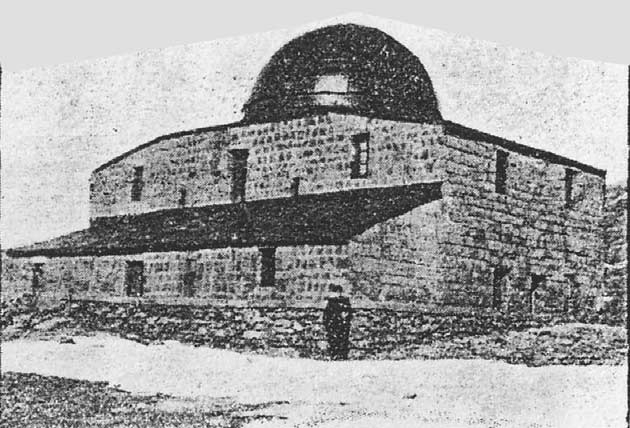
Figure 3. Osservatorio Etneo ‘Mt Etna Observatory’.
similar station on Mt Vesuvius, which had been granted a royal charter and was equipped with appropriate scientific instruments as well as in receipt of significant funding (Policastro, 1928e, p. 34).
Before 1927, the facilities for welcoming visitors to (and, indeed, rescuing them from) the summit of Mt Etna were in a parlous state. The situation began to change, albeit slightly, after 1927, when ASTIS persuaded the University of Catania to grant the use of premises on the first floor of the Observatory, in order to transform them into a comfortable shelter with a full-time guardian so the place would be accessible at any time of day or night (Ponte, 1927, pp. 53−55). The inauguration of the wonderful Paradiso dell’Etna guesthouse, placed in an evocative position with a first-rate cafe´ and restaurant attached, can be traced back to 1929 (APTC, 2001, p. 9, 19). As ASTIS director Giuseppe Paternostro had already pointed out, it would be only reasonable to make raising awareness of the volcano a national issue, given Mt Etna’s enormous scientific importance and its worth as a site of natural interest (Policastro, 1928f, pp. 18−19), as well as the powerful appeal of the many sites and places around and on the volcano (Policastro, 1930c, pp. 38−40, 1931a, pp. 5−7). Of course, the question of enhancing Mt Etna’s profile was, at heart, a question of access and the state of the roads, an issue which had been much discussed in the past and which had produced a number of proposals reflecting a range of different and
differing interests and points of view (Policastro, 1928e, p. 33).
The Bourbon government had begun to tackle the problem as early as 1833, with the construction of a carriage road from Barriera del Bosco to the Grotta degli Inglesi. The first stretch of the road reached Nicolosi and was then extended as far as the Benedictine monastery San Nicolo` Vecchio. After the collapse of the Bourbon government, the project remained incomplete, as the development of tourism here was not a priority (Policastro, 1928f, p. 19). In the second half of the 1920s, when the spotlight was once again turned on the question of completing the road up Mt Etna, an alternative to the former project to extend the road from Nicolosi was put forward by Emerico Vismara. The new project involved a road which was to start near Zafferana and then climb up through beautiful woods for about nine kilometres until it reached a plain at around 1500 metres above sea level on the western side of the mountain, which offered views not only of the summit crater but also a sweeping
panorama over the western coast of Sicily, from the Strait of Messina to Syracuse. Vismara and his supporters believed that the site was ideal for tourists and holidaymakers, the perfect place to build villas and hotels (Vismara, 1928, pp. 17−18). The dilemma over the choice evaporated in 1931 when arrangements were finally made to build the road up Mt Etna and a consortium was given the task of building it. It was formed by the Provincial Authority of Catania, Banco di Sicilia, ASTIS, the Provincial Economic Council, the municipalities of Catania, Linguaglossa, Masca-lucia, Belpasso and the entrepreneur Costarelli. Although Vismara’s project had a certain charm, it was rejected in favour of a project drawn up years earlier by another engineer, Puglisi, which in all likelihood offered a better match between the advantages for science and tourism and commercial gains, especially in terms of the distribution of agricultural produce. The Provincial Authority’s chief engineer did make a number of radical changes to Puglisi’s project, expanding the curves and widening the roads as well as extending the full road which would no longer start out from an old path near Monterossi, as originally planned, but would now be an extension of the Mascalucia−Nicolosi road. The first stretch, about 10 kilometres long, was to link the town of Nicolosi with the Ferrandina Wood and from there the road would go on to the Cantoniera Meteorica − weather station − crossing over cultivated land under vine and then stretches of lava from the 1886 and 1910 eruptions, until, winding its way through fruit groves and woods of chestnut and pine trees, it reached the area known as Piano della Bottara. The plans included the construction of a large semi-circular space to park and manoeuvre vehicles (Carlisto,
1932a, pp. 99−102; Policastro, 1930a, pp. 42−44, 1931c, pp. 50−51).
As planned, the construction of the Etna Road also offered the ideal opportunity to raise the profile of the many sites and towns in the volcano’s foothills (Policastro, 1933, p. 473), first and foremost the city of Catania, where the Castello Ursino was being restored. The local Comitato Turistico − the committee created in 1933 by the Provincial Council for Economic Cooperation − was charged with the task of boosting tourist traffic (Consiglio Provinciale dell’Economia Corporativa di Catania [CPECC], 1934, pp. 55−56), taking advantage of the winter sports organized on Mt Etna and using the recently opened ‘Gino Mensa’ mountain refuge (Longhena, 1933, pp. 400−401). A committee, specially appointed in the first instance by ASTIS, continued to ensure the organization of the two existing mountain shelters, namely the weather station and observatory shelter − also known as the Marco Gemmellaro refuge − which had a reduced charge of 30 lire for an overnight stay, including heating, electricity in the bedroom and running water in the bathroom. For some years, visitors had been able to enjoy food provided on site at reasonable cost.8 Later, in 1936, the Grande Albergo dell’Etna, along with the Vitelli mountain refuge, was to be inaugurated (APTC, 2001, p. 12).
The construction of the ‘Etna Road’ opened whole new avenues for the promotion of towns and sites which offered a combination of charming nature and appealing climate as well as archaeological, architectural and cultural attrac-tions. The town of Acireale offered a great deal, and had been officially approved as a ‘Stazione di Cura, Soggiorno e Turismo’ because of the excellent properties of its spa and mineral waters (Grassi Badala` di Mangano, 1929, pp. 54−55). The spa of this sun-kissed town had in the past enjoyed a certain fame. The old Grand Hotel, built by Baron Agostino Pennisi di Floristella, had also known its spell of success and glory (Figure 4). For a number of reasons the town had then experienced years of
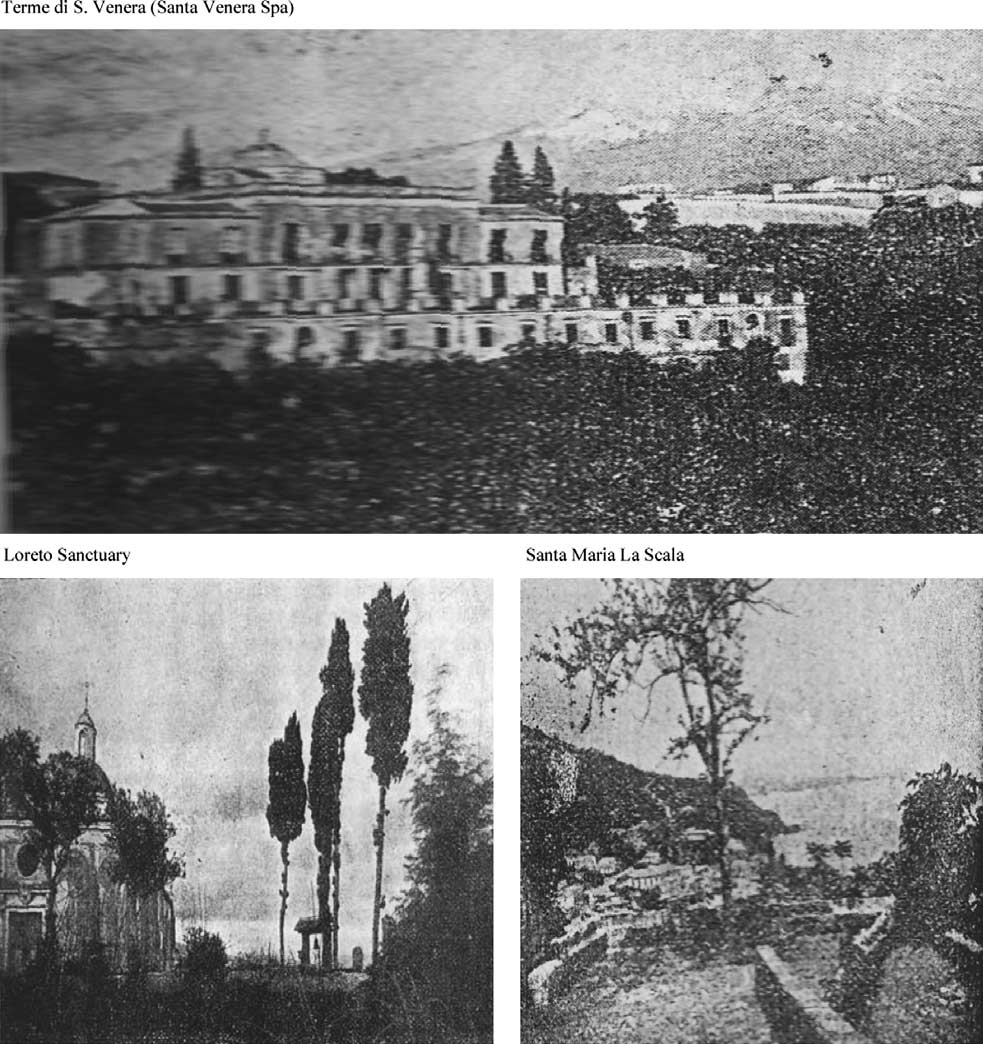
Figure 4. Acireale.
decline. In the early 1930s, new horizons made a renaissance seem possible. The national tourism agency had done its part, publicizing at home and abroad the therapeutic qualities of the spa and the natural charms of the area, by means of a fine publication with an ample collection of photos, printed in a number of languages. The spa’s organizational committee was also meant to undertake necessary restoration work on the complex to enhance the exterior and to introduce the kind of modern equipment and facilities that were available in the most fashionable spa resorts (Policastro, 1930b, pp. 33−37). Last, but not least, the committee also had to take steps to eliminate bottlenecks on local roads (Policastro, 1931b, pp. 51−52).
The promotion of Randazzo was also thought to be important. The town preserved many historical and artistic treasures within its ancient walls. The hopes of the municipal authorities of gaining greater scope and raising the town’s profile were
further kindled when in addition to the construction of the ‘Etna Road’, work was begun on the Giardini−Randazzo railway line, which would have connected the town with Taormina. The significance in tourism terms of this initiative spurred the decision to build another road on Mt Etna, starting from Randazzo. The road was to reach an altitude of over 2000 metres and allow the Church of Santa Maria, the municipal council and Banco di Sicilia to plant uncultivated lands belonging to them. The new possibilities also led to plans being made for a new hotel equipped with all modern facilities. Furthermore, to provide a solid foundation for growth in the tourism sector, schemes were drawn up to ensure the water supply and the building of sewers (Carlisto, 1932b, pp. 292−293). Although progress had been made, the tourist development of the Catania area was still to be hindered by the limited exploitation of its harbour for the regular tourist traffic (ASEMT, 1933, p. 77).
Tourism in Sicily on the eve of the Second World War
The early 1920s saw increased interest in compiling more precise data on the movement of tourists that would yield a more reliable picture of the situation and provide central government with material for further reflection, in order to find a match between propaganda meant strictly to promote economic interests on the one hand, and to boost appreciation for the efficiency of the fascist regime on the other (Menicucci, 1928, pp. 30−32). The statistical data collected by ENIT, using increasingly precise and refined methodologies (Avancini, 1925, pp. 5−11, 1933; ENIT, 1925, pp. 59−60, 1926, p. 55), pointed out some interesting considerations concerning the Sicilian tourist sector in comparison with the trend of the country and the other regions with significant tourist traffic. In particular, the prevalence of Italian domestic tourists was constantly noted on a national scale, and in this regard Sicily was well to the fore, above all as far as the arrivals were concerned − in 1928, first position in the country with almost 932,000 arrivals; in 1931, second position with almost 800,000 arrivals, below Lombardy with more than 1,000,000 arrivals. As regards foreign tourists’ stays, on the other hand, Sicily was in a less prominent position, especially if compared with Tuscany.
In the national list relative to foreign visitors in 1928, Sicily occupied the ninth and 10th positions for arrivals and number of nights spent, respectively, a long way behind the leading positions (Avancini, 1930, pp. 32−33, 1934, pp. 32−33). This was despite an encouraging outcome in 1922, when a 200% increase in the arrivals was remarked in Sicily in comparison with the 100% increase recorded nationally. But during the 1930s Sicily showed a declining trend in tourist arrivals, above all in percentage terms, with respect to the national picture. Sicily’s share of foreign tourist traffic fell from 4.44 to 3.79% during the decade; and simultaneously a reduction from 10.56 to 6.29% in the domestic tourist traffic share was also remarked (Avancini, 1930, pp. 32−33, 1934, pp. 32−33; ENIT, 1925, p. 60; Niceforo, 1923, p. 59). As regards foreign tourist traffic, Sicily was in a modest position on a national scale. However, in the context of Southern Italy and the islands, it occupied the second position, although a long way behind Campania. Nevertheless, the superiority of Sicily over the other regions of Southern Italy and over other Italian islands was very evident (Avancini, 1930, pp. 32− 33, 1934, pp. 32−33; ENIT, 1925, p. 60; Niceforo, 1923, pp. 44−59): even the other large Italian island, Sardinia, was not yet considered as a tourist destination (Larco, 1931, pp. 145−153). Sicily kept its superiority as well to the other Mediterranean
islands at least up to the end of the 1930s, when it found itself competing with the tourist development of the Balearic Islands (Buades, 2004). However, competition among tourist areas was to develop again after the Second World War, and above all starting from the 1960s, because of the rise of Sardinia (Battilani, 2001, pp. 278−287), Malta (Lockhart, 1997, pp. 145−152; Lockhart & Ashton, 1991, pp. 22−32; Spiteri, 1968), the Greek islands and many other tourist areas inside and outside Europe (see, for example, Barke, Towner & Newton, 1996; Battilani, 2001, pp. 133−178; Black, 1996, pp. 118−120; Harrop, 1973, pp. 55−72).
In the 1930s, ‘the Mediterranean travel destinations, which had earlier been very popular, felt themselves threatened’ by competition from new locations (Syrja¨maa, 2007, p. 356). The origin of foreign tourists to Italy was to change significantly, with a progressive reduction in French, English and Americans, and a simultaneous increase in people coming from central Europe. These people preferred to stay in the central and northern parts of Italy, that were very well equipped with the modern fashion trends promoting Mediterranean seaside tourism (Battilani, 2007, pp. 491− 499; Pellejero Martinez, 2007, pp. 143−145). The development of this kind of tourism in Sicily was hindered by the inadequacy of basic facilities and infrastructures (railways, roads and harbours), due to the limited funds supplied by the fascist regime. Even Mazzaro` beach, below the flagship destination of Taormina, had been neglected by the regime and was slow to gather momentum (ASEMT, 1933, p. 64). However, above all thanks to private investments, both the Mondello beach in Palermo, and the Mazzaro` and Isola Bella beaches in Taormina, were adequately equipped to welcome the numerous tourists who stayed in these places in summer and in the other seasons of the year (Battilani, 2001, p. 272).
The building of various stretches of new road could not compensate for the poor state of the existing roads, especially in the interior, where they were both in bad repair and insufficient. Despite its many disadvantages, the transport of tourists by road was nonetheless highly competitive compared with rail transport, as the railway network continued to be very inadequate, narrow gauge and not powered by electricity, even over those short stretches which carried a lot of traffic (Colombo, 1932, pp. 347−351).
Furthermore, in the 1930s most foreigners reached the island by sea, and an increase in tourist traffic would have been unthinkable without major improvements to Sicily’s ports, which were not equipped to offer safe and practical mooring to the largest passenger ships. Due to the deficiencies of its ports, Sicily was excluded from the routes navigated by the large companies offering regular sea crossings or cruises. In the few cases where insistent pressure succeeded in having the island included on a route, the results were so catastrophic as to discourage any further attempts (Ardizzone, 1927, pp. 25−28). No Sicilian port other than Messina was able to handle the large modern passenger ships which had a draught of more than five metres. The situation did not improve much in subsequent years, as the efforts to modernize port facilities focused on increasing their capacity to handle goods rather than to transport passengers. The carriers were private and state-owned ships, of modest dimensions, which ran regular routes to different parts of the world, especially the colonies. Even in Palermo, the port meant to handle most passenger traffic, the number of passengers remained persistently low (Imborbone, 1931, pp. 14−16; Palermi, 1929, pp. 4−8; Pennavaria, 1930, pp. 1−6; Servadio, 1930, pp. 17−28).
The positive results obtained in the 1920s were mostly due to the large efforts lavished by ASTIS. This organization, as the representative of ENIT, allowed the national problem of the lack of a reliable hotel classification to be overcome, in Sicily as elsewhere, and then selected the hotels to be inserted in the Official Annual. In the late 1930s, 158 Sicilian hotels that had accepted ASTIS rules and offered the best guarantees of quality of service to the foreign tourists were listed in the Annual. On the other hand, the overall picture of the hotels on offer in Sicily continued to be somewhat disappointing as regards middle-class tourists.
Thus, in the years leading up to the outbreak of Second World War, there were very few private tourism agencies and transport companies in Sicily. Moreover, although Sicily was the third most extensive region by geographical area in Italy, it was only 11th in the ranking of hotel sector development. There was a considerable gap between Sicily and the regions that came before it in this list, in terms of accommodation providers, rooms, beds and bathrooms. Sicily presented 165 accommodation providers with 4357 rooms, as compared with 878 providers and 22,343 rooms in Lombardy, 812 providers and 19,014 rooms in Piedmont, and 672 providers and 17,552 rooms in Veneto. There was a similar situation with the number of beds and bathrooms. Sicily presented 6711 beds and 778 bathrooms, correspond-ing respectively to 2.7 and 3.2% of the total. Lombardy had 33,374 beds (13.8%) and 3459 bathrooms (14.1%). Piedmont had 28,333 beds (11.3%) and 2790 bathrooms
(11.4%). Veneto had 27,055 beds (10.8%) and 2624 bathrooms (10.7%). The province of Florence alone was better equipped than the whole of Sicily.
The hotel industry in Sicily was essentially concentrated in cities with over 50,000 inhabitants and while the number of luxury hotels was adequate and the number of first-class hotels not seriously inadequate, the number of second-class hotels was particularly low. The failures of the hotel sector were widespread. Of the 158 hotels listed in the ENIT annual, only 45 had at least one room with private bathroom, only 68 had hot and cold water in the rooms, only 55 had running cold water, while only 64 hotels had central heating, 16 had telephones in the rooms or on the landing, 40 had buses, 37 had garages and 10 had tennis courts. The situation was even worse for guesthouses. There were only 23 guesthouses in the whole of Sicily, of which five were first class and seven were second; between them they had 345 rooms with 76 bathrooms. A number of provinces − Agrigento, Caltanissetta, Catania, Enna, Ragusa and Trapani − could not boast a single guesthouse worthy of being included in the Official Annual. The difference in tourist traffic compared with other regions was more significant in terms of tourist stays than arrivals; for example, in 1938 Sicily registered 2,043,050 stays compared with 735,019 arrivals, while Tuscany registered 6,518,664 stays for a number of arrivals that was only a little higher than the Sicilian equivalent, 920,948 (Mariotti, 1946, pp. 14−15).
On the whole, during the fascist period, state and local bodies had without doubt contributed to promoting the tourist culture of the island, and offered some appreciable opportunities. But the investments were modest, and yielded only limited results. Only much larger investments would have enabled a real transformation of the Sicilian tourism industry, opening out wider markets by bringing into play the beauty of its beaches and scenery, as well as the important (and dominant) archaeological and artistic heritage. In any case, we can emphasize in conclusion that, despite the serious obstacles that limited Sicily’s development as a tourist destination, the island justifies analysis for some important examples of efficiency
and capacity of adaptation to the trends of the period. It could not compete with the most successful Mediterranean destinations of the inter-war years, but it did achieve important successes in meeting the new challenges associated with the growth of international tourism markets in this transitional period.
Notes on contributor
Silvana Cassar is a Research Associate and teaches Economic History at the Faculty of Economics of the University of Catania, Italy. She is currently concerned with the evolution of the Sicilian Economy during the last centuries, with particular reference to the situation in the twentieth century.
Notes
The Foundation for the cultural and economic development of Sicily was founded and managed by the Banco di Sicilia (see Mormino, 1926, p. 110; Policastro, 1928a, pp. 23−24).
The ‘Aziende di CST’ were financed through a tourism tax and the ‘imposta di cura’ or a local levy and by means of an occasional special surcharge, in addition to revenue tax, levied on the cost of tickets to various performances (Paternostro, 1946b, p. 17).
To compare with Germany under the Nazis and Spain under Primo de Rivera, see, for example, Semmens, 2005b; Baranowski, 2004 and Moreno Garrido, 2007.
The Minister, Belluzzo, was favourably impressed and acknowledged the final call for action, approving the issue of large sums in prizes or supplies (Policastro, 1928g, p. 44).
Paternostro made a thorough survey of the roads problem. He not only listed the fundamental measures needed, but also gave advice and suggestions in order to overcome the more serious obstacles (Policastro, 1928c, pp. 38−40).
For example, in 1930, foreign tourists bought an aggregate of 12,973 rail tickets at reduced fare: 1322 for the first class; 7946 for the second class and 3705 for the third class (Avancini, 1934, p. 8).
To avoid discontent in the wake of reduced revenues, the provincial tourism bodies received subsidies and compensation (Paternostro, 1946b, p. 17).
Both shelters were heated by petrol stoves. In the observatory refuge, running water was obtained from the condensation of the water vapour from a nearby volcanic vent and electricity was produced by a Delko Light generator (Ponte, 1932, p. 230).
References
Ardizzone, G. (1927). I porti siciliani in relazione al turismo. Problemi siciliani, IV(2), 25−28. Associazione per lo Sviluppo del Turismo in Sicilia (ASTIS). (1926). Statuto [Statute]. Milano:
Stabilimento Tipo-litografico A. Macchi.
Associazione per lo Sviluppo del Turismo in Sicilia (ASTIS). (1929a). Giri turistici regolari in automobile. Sicilia Industriale ed Agricola, XII(510), 4.
Associazione per lo Sviluppo del Turismo in Sicilia (ASTIS). (1929b). Prospetti dei servizi regolari di Grande Turismo redatti dall’Associazione per lo sviluppo del turismo in Sicilia. Archivio Centrale di Stato. Presidenza Consiglio Ministri, 86(1928−1930), 3-1.2-10271.
Associazione per lo Sviluppo del Turismo in Sicilia (ASTIS). (1930). Sviluppo del turismo in Sicilia. Costruzione di autostrada all’Osservatorio dell’Etna. Archivio Centrale di Stato. Presidenza Consiglio Ministri, 86(1928−1930), 3-2.1-10326.
Associazione per lo Sviluppo Economico del Mezzogiorno e per il Turismo (ASEMT). (1933). III Convegno turistico del Mezzogiorno e delle Isole (14−16 febbraio 1933) [The III Tourism Congress of the Italian South and Islands (14−16 February 1933)]. Napoli: Stabilimento Tipografico Editoriale-Palazzo della Borsa.
Automobile Club Sicilia (ACS). (1929). Riduzioni ferroviarie per la ‘‘Primavera Siciliana’’.
Sicilia Industriale ed Agricola, XII(510), 2.
Avancini, M. (1925). Entita` e svolgimento del traffico turistico in Italia. Dati e congetture [Degree of and trends in tourist traffic in Italy. Data and forecasts]. Roma: Tipografia del Senato.
Avancini, M. (1930). Statistica del movimento turistico (anno 1928) [Tourism statistics (year 1928)]. Roma: Tipografia Castaldi.
Avancini, M. (1933). Statistica turistica. In C. Gini (Ed.), Trattato elementare di statistica [Introduction to statistics] (Vol. VI, pp. 1−25). Milano: A. Giuffre´.
Avancini, M. (1934). Statistica del movimento turistico in Italia (anno 1931) [Statistics on tourism movement in Italy (year 1931)]. Roma: Tipografia Castaldi.
Azienda Provinciale Turismo di Catania (APTC). (2001). Sessantacinque anni per il turismo (1935−2000) [Celebrating sixty-five years of tourism (1935−2000)]. Palermo: Officine Grafiche Riunite.
Balsamo, P. (1809). Giornale del viaggio fatto in Sicilia e particolarmente nella Contea di Modica [Journal of a journey in Sicily and in particular in the County of Modica]. Palermo: Reale Stamperia.
Baranowski, S. (2004). Strength through joy: Consumerism and mass tourism in the Third Reich.
Cambridge: Cambridge University Press.
Barke, M., Towner, J., & Newton, M.T. (Eds.). (1996). Tourism in Spain: Critical issues.
Wallingford, CT: CAB.
Battilani, P. (2001). Vacanze di pochi vacanze di tutti. L’evoluzione del turismo europeo [Holidays for the few, holidays for the masses. Evolution of tourism in Europe]. Bologna: il Mulino.
Battilani, P. (2007). La democratizzazione del turismo nel Mediterraneo vista attraverso le trasformazioni del sistema ricettivo. In P. Battilani & D. Strangio (Eds.), Il turismo e le citta` tra XVIII e XXI secolo. Italia e Spagna a confronto [Tourism and towns between XVIII and XXI century. A comparative study of Italy and Spain] (pp. 477−499). Milano: FrancoAngeli.
Berrino, A. (2005). La nascita delle Aziende autonome e le politiche di sviluppo locale in Italia tra le due guerre. In A. Berrino (Ed.), Storia del turismo. Annale 2004 [History of tourism. Year 2004] (pp. 33−54). Milano: FrancoAngeli.
Berrino, A. (2007). Le citta` italiane nell’evoluzione del turismo nel Novecento. In P. Battilani & D. Strangio (Eds.), Il turismo e le citta` tra XVIII e XXI secolo. Italia e Spagna a confronto [Tourism and towns between XVIII and XXI century. A comparative study of Italy and Spain] (pp. 73−88). Milano: FrancoAngeli.
Black, A. (1996). Negotiating the tourist gaze: The example of Malta. In J. Boissevain (Ed.), Coping with tourists. European reactions to mass tourism (Vol. 1, pp. 112−142). Oxford/New York: Berghahn Books.
Black, J. (2003). Italy and the grand tour. New Haven/London: Yale University Press. Bosworth, R.J.B. (1997). Bosworth, ‘The Touring Club Italiano and the nationalization of the
Italian bourgeoisie’. European History Quarterly, 27(1997), 371−410.
Bradley, W.F. (1965). Il romanzo della Targa Florio [The Targa Florio story]. Bologna: Edizioni Calderini.
Buades, J. (2004). On brilla el sol: turisme a Baleares abans del boom [Where the sun shines: tourism in the Balearics before the boom]. Eivissa: Res Publica Edicions.
Canestrini, G. (1966). La favolosa Targa Florio [The wonderful Targa Florio]. Roma: LEA.
Carlisto, P.O. (1932a). Alla conquista e valorizzazione dell’Etna. La costruzione della suggestiva strada turistica. Rivista dell’Industria, VI(2), 99−102.
Carlisto, P.O. (1932b). Randazzo turistica. Rivista dell’Industria, VI(5), 292−293. Colombo, A. (1932). Opere pubbliche in Sicilia. Le Vie d’Italia, XXXVIII(5), 347−355.
Consiglio Provinciale dell’Economia Corporativa di Catania (CPECC). (1934). Atti del Consiglio Provinciale dell’Economia Corporativa di Catania nel biennio 1932−1933 [Acts of the Catania Provincial Council on Corporation Economy for the years 1932−1933]. Catania: Stabilimento Tipografico Fratelli Viaggio & Campo.
Darioski. (1929). I compiti politici del turismo. (1929). Rivista dell’Industria, III(1), 50−52.
Dawes, B. (2003). La rivoluzione turistica. Thomas Cook e il turismo inglese in Italia nel XIX secolo [The tourism revolution. Thomas Cooke and English tourism in Italy in the XIX century]. Napoli: Edizioni Scientifiche Italiane.
De Seta, C. (2001). L’Italia del Grand Tour. Da Montagne a Goethe [Italy and the Grand Tour.
From Montagne to Goethe]. Napoli: Electa.
Ente Nazionale Industrie Turistiche (ENIT). (1925). Relazione sull’attivita` svolta nell’anno 1924 e nel primo quinquennio (1920−24) [Report on work carried out in 1924 and the first five-year period (1920−1924)]. Roma: Tipografia del Senato.
Ente Nazionale Industrie Turistiche (ENIT). (1926). Relazione sull’attivita` svolta nel 1925 [Report on the work carried out in 1925]. Roma: Tipografia del Senato.
Ente Nazionale Industrie Turistiche (ENIT). (1930). Relazione sull’attivita` svolta nell’anno 1929 [Report on the work carried out in 1929]. Roma: Tipografia del Senato.
Garc`ıa, G.A. (1986). La Targa Florio (Gattopardi. Piloti. Gentiluomini) [The Targa Florio motor race (Leopards. Drivers. Gentlemen)]. Palermo: Novecento.
Giannico, G. (2007). Investimenti nella ricettivita` alberghiera nel Sud Italia. Dai primi albergatori di Capri all’arrivo dei ‘‘milanesi’’. In A. Berrino (Ed.), Storia del turismo. Annale 2005 [History of tourism. Year 2005] (pp. 35−51). Milano: FrancoAngeli.
Grassi Badala` di Mangano, P. (1929). La solenne cerimonia dell’insediamento della presidenza e del Comitato di Amministrazione della Stazione di Cura Soggiorno e Turismo ad Aci Reale. Rivista dell’Industria, III(1), 54−55.
Guerra, C. (1784). Memoria sulle strade pubbliche della Sicilia [Report on the state of the public roads in Sicily]. Napoli: Raimondi.
Harrop, J. (1973). On the economics of the tourist boom. Bulletin of Economic Research, 25(1), 55−72.
Imborbone, A. (1931). La funzione mediterranea della Sicilia. Problemi siciliani, VIII(9), 14− 16.
Jameson, F. (1983). Pleasure: A political issue. In F. Jameson & T. Bennett (Eds.), Formations of pleasure (pp. 1−12). London: Routledge & Kegan Paul.
Larco, R. (1931). Sardegna poco nota. Nel dominio della montagna e del mare. Le Vie d’Italia, XXXVI(2), 145−153.
Lockhart, D.G. (1997). We promise you a warm welcome: Tourism to Malta since the 1960s.
GeoJournal, 41(2), 145−152.
Lockhart, D.G., & Ashton, S.E. (1991). Tourism in Malta. Scottish Geographical Magazine, 107(1), 22−32.
Longhena, G. (1933). Catania nei suoi commerci e nelle sue industrie. Rivista dell’Industria e dell’Artigianato, VII(12), 459−476.
Mariotti, A. (1923). L’industria del forestiero in Italia [Serving foreign travelers]. Bologna: N. Zaninelli.
Mariotti, G. (1946). Per lo sviluppo del turismo in Sicilia. Bollettino mensile − Banco di Sicilia (Osservatorio economico) 2th series, 1(2), 13−16.
Menicucci, V. (1928). Il forestiero propagandista del fascismo. Rivista dell’Industria, II(9), 30− 32.
Moreno Garrido, A. (2007). Historia del Turismo en Espana en el Siglo XX [History of tourism in Spain in the XX century]. Madrid: Editorial S´ıntesis.
Mormino, I. (1926). L’attivita` del Banco di Sicilia nel 1925. Problemi Siciliani, III(5), 103−110. Niceforo, A. (1923). Il movimento dei forestieri in Italia [The movement of foreign travelers in
Italy]. Roma: Tipografia del Senato.
O’Neill, C. (2005). The most magical corner of England’: Tourism, preservation and the development of the Lake District, 1919−39. In J.K. Walton (Ed.), Histories of tourism. Representation, identity and conflict (pp. 228−244). Clevedon, UK: Channel View.
Palermi, R.V. (1929). Il commercio portuario e ferroviario della Sicilia. Problemi siciliani, VI(1), 4−8.
Paloscia, F. (1994). Storia del turismo nell’economia italiana [History of tourism in the Italian economy]. Citta` di Castello, PG: Petruzzi.
Paloscia, F. (2004). Il turismo nell’economia italiana. Dall’Unita` d’Italia a oggi [Tourism in the Italian economy. From Italian Unification to the present day]. Roma: Agra.
Paternostro, G. (1929a). La viabilita` turistica della Sicilia [Tourists and the state of roads in Sicily]. Palermo: Industrie Editoriali Riunite.
Paternostro, G. (1929b). Del turismo in Sicilia. Problemi siciliani, VI(9), 1−3.
Paternostro, G. (1946a). Il potenziamento del patrimonio idrotermale della Sicilia [Enhancing wate and spa assets in Sicily]. Palermo: Stabilimento Tipografico IRES.
Paternostro, G. (1946b). Problemi della rinascita: La ricostituzione dell’organizzazione turistica in Sicilia nel quadro dell’autonomia regionale. Bollettino mensile − Banco di Sicilia (Osservatorio economico) 2th series, 1(3), 15−22.
Paternostro, G. (1947). La viabilita` turistica in Sicilia [Tourists and the state of roads in Sicily].
Palermo: Stabilimento Tipografico IRES.
Pellejero Martinez, C. (2007). El auge del turismo en Malaga durante el reinado de Alfonso III (1902−1931). In P. Battilani & D. Strangio (Eds.), Il turismo e le citta` tra XVIII e XXI secolo. Italia e Spagna a confronto [Tourism and towns between XVIII and XXI century. A comparative study of Italy and Spain] (pp. 127−155). Milano: FrancoAngeli.
Peniston-Bird, C.M. (2005). Coffee, klimt and climbing: Construction an Austrian national identity in tourist literature 1918−1938. In J.K. Walton (Ed.), Histories of tourism. Representation, identity and conflict (pp. 162−178). Clevedon, UK: Channel View.
Pennavaria, F. (1930). Le comunicazioni marittime e ferroviarie della Sicilia. Problemi siciliani, VII(3), 1−6.
Policastro, G. (1928a). Il Banco di Sicilia. Rivista dell’Industria, II(2), 19−26.
Policastro, G. (1928b). Per un convegno turistico siciliano. Rivista dell’Industria, II(5), 39−41. Policastro, G. (1928c). La strada turistico-archeologica di Sicilia. Rivista dell’Industria, II(6),
38−40.
Policastro, G. (1928d). Aci Castello. Rivista dell’Industria, II(7), 41−42.
Policastro, G. (1928e). L’ascesa dei delegati regionali della FIE al vulcano ed il Congresso al Municipio. Rivista dell’Industria, II(8), 19−35.
Policastro, G. (1928f). Per la valorizzazione dell’Etna e per lo sviluppo dell’industria dei forestieri in Sicilia. Rivista dell’Industria, II(8), 18−19.
Policastro, G. (1928g). L’ASTIS e le sue iniziative. Rivista dell’Industria, II(10), 41−50.
Policastro, G. (1930a). La sistemazione turistica della zona etnea e la sistemazione stradale della nostra provincia. Rivista dell’Industria, IV(2), 42−44.
Policastro, G. (1930b). Aci Reale, Stazione di cura, soggiorno e turismo. Rivista dell’Industria, IV(4), 33−37.
Policastro, G. (1930c). Panorami turistici della provincia di Catania. La ‘‘grande’’ e la ‘‘piccola’’ cornice dell’Etna. Rivista dell’Industria, IV(11), 38−40.
Policastro, G. (1931a). 1930−1931. Rivista dell’Industria, IV(12), 5−7.
Policastro, G. (1931b). Il nuovo Presidente ed i componenti del Comitato di cura soggiorno e turismo di Acireale. Rivista dell’Industria, V(8), 51−52.
Policastro, G. (1931c). La strada sull’Etna. Rivista dell’Industria, V(8), 50−51.
Policastro, G. (1933). La Sicilia com’e` oggi. Rivista dell’Industria e dell’Artigianato, VII(10), 387−408.
Ponte, G. (1927). L’Etna meta di turisti di tutto il mondo. Rivista dell’Industria, I(1−2), 53−55. Ponte, G. (1932). L’interessamento dell’ASTIS per i rifugi etnei. Rivista dell’Industria, VI(4),
230.
Restifo, G. (1996). Taormina, da borgo a citta` turistica [Taormina, from village to tourism destination]. Messina: Sicania.
Restifo, G. (2000). Tourism and the history of Taormina, 1750−1950. Lampeter: Edwin Mellen. Scrofani, S. (1791). Memoria sulla liberta` del commercio dei grani della Sicilia, presentata a S.
M. il Re di Napoli [Report on the freedom of trade in grain in Sicily, presented to His Majesty the King of Naples]. Firenze: G. Tofani.
Semmens, K. (2005a). Travel in merry Germany: Tourism in the Third Reich. In J.K. Walton (Ed.), Histories of tourism. Representation, identity and conflict (pp. 144−161). Clevedon, UK: Channel View.
Semmens, K. (2005b). Seeing Hitler’s Germany: Tourism in the Third Reich. Basingstoke: Palgrave Macmillan.
Senio. (1929). Il turismo e la Sicilia. (1929). Problemi Siciliani, VI(2), 26−27. Servadio, U. (1930). I lavori del porto di Catania. Rivista dell’Industria, IV(7), 17−28.
Spiteri, L. (1968). The development of tourism in Malta. Malta: The Joint Consultative Council.
Syrja¨maa, T. (1997). Visitez l’Italie. Italian State tourist promotion abroad 1919−1943: Administrative structure and practical realization. Turku: Turun Yliopisto.
Syrja¨maa, T. (2007). A new phase and a new actor in modern international tourism: Italian State tourist promotion abroad in the interwar period. In P. Battilani & D. Strangio (Eds.), Il turismo e le citta` tra XVIII e XXI secolo. Italia e Spagna a confronto [Tourism and towns between XVIII and XXI century. A comparative study of Italy and Spain] (pp. 344−357). Milano: FrancoAngeli.
Touring Club Italiano (TCI). (1925a). Bando del 28 concorso per il miglioramento dei piccoli
alberghi. Le Vie d’Italia, XXXI(2), 199−201.
Touring Club Italiano (TCI). (1925b). Il concorso nazionale di camere, bagni, ritirate per alberghi minori. Le Vie d’Italia, XXXI(2), 197−199.
Touring Club Italiano (TCI). (1930). Riduzioni ferroviarie per il pubblico. Le Vie d’Italia, XXXVI(5), 221.
Touring Club Italiano (TCI). (1932). Nuove norme per i biglietti di andata-ritorno a prezzo ridotto. Le Vie d’Italia, XXXVIII(12), 447−449.
Vismara, E. (1928). Un grande problema nazionale. La valorizzazione dell’Etna. Rivista dell’Industria, II(4), 9−18.
Walton, J.K. (2005). Paradise lost and found: Tourists and expatriates in El Terreno, Palma de Mallorca, from the 1920s to the 1950s. In J.K. Walton (Ed.), Histories of tourism. Representation, identity and conflict (pp. 179−194). Clevedon, UK: Channel View.