13 - John McCourt, "The Years of Bloom: James Joyce in Trieste" (2000)
| Site: | Bryn Mawr Moodle |
| Course: | ESEM007 - Wonders of Italy |
| Book: | 13 - John McCourt, "The Years of Bloom: James Joyce in Trieste" (2000) |
| Printed by: | Guest user |
| Date: | Sunday, September 13, 2026, 1:08 PM |
1. index.htm
John McCourt, The Years of Bloom: James Joyce in Trieste 1904-1920, Dublin: The Lilliput Press, 2000
Ten days in Trieste
In the early afternoon of 20 October 1904, a young “gentleman, Irish, mighty odd,” and his even younger female companion stepped wearily off the train that had just arrived at Trieste’s busy Stazione Centrale. The couple, as yet unmarried, were James Joyce and Nora Barnacle, aged twenty-two and twenty respectively. They had met just four months earlier in Dublin and had united to defy convention and leave their country, their religion and their families in order to embark on a new life together on the continent. Unlike so many Irish immigrants, they were not following a familiar path to England or America but were destined for a singular adventure in the heart of Europe.
Financed by Lady Gregory (five pounds), a disapproving George Russell (ten shillings), John Stanislaus Joyce (he later claimed to have contributed seven pounds), and various other benefactors, they had departed on 8 October for Holyhead on the ferry from Dublin’s North Wall. Joyce was seen off by his father, his sister Poppie, his brother Stanislaus and his aunt Josephine Murray, while Nora boarded separately and alone: Joyce did not want his father to meet her or know anything about her, and she herself had a chosen to keep her own family in Galway in the dark about her flight.
[…] After their night in Laibach (Ljubljana), they boarded the first train for Trieste. On arriving there, Joyce, as he had done in Paris, left Nora in the park in front of the station and walked into the town center in order to make arrangements for the night. She probably did not know it, but she was sitting in the shadow of the imposing statue of the Emperor Franz Joseph’s beautiful long-haired wife, the Empress Elisabetta, or “Sissi” as she was fondly known, who had been assassinated on 10 September 1898 and whose statute commemorated five hundred years of Austrian rule in the city.
When he reached the Piazza Grande, the rather regal central square that looks imperiously out to sea, Joyce became involved in a dispute involving a few deserting English sailors. Their drunken and disorderly behavior had aroused the attention of a local policeman, who had approached and was in the process of arresting them when Joyce, perhaps keen to show off his Italian, intervened on their behalf. Unfortunately he only succeeded in having himself arrested along with the others. Stanislaus Joyce paints a typically colorful and indignant description of the misfortunes suffered by his brother on his first day in Trieste: “he was accosted in the Piazza Grande by three drunken English sailors. The sailors were arrested and the guardia asked Jim would he go with them as interpreter because he spoke Italian so well. Jim consented like a mug.” When they reached the police station, the Casa Castagna on via San Nicolò, Joyce found himself being put in a cell along with the others and insisted that the British Consul be called. When “that worthy,” His Britannic Majesty’s Consul for Dalmatia, Carniola and the Austrian Littoral, a career diplomat named Harry L. Churchill, finally turned up, Joyce informed him that he was “a Bachelor of Arts of the Royal University of Ireland” who had just arrived in Trieste to take up a position as a teacher in the Berlitz School. “The Consul of great, free England, after all had been explained to him, instead of resenting the unwarranted arrest in the public thoroughfares of an English subject (for it amounted to that) and his being run in with rowdy sailors, hoped Jim hadn’t committed a felony in England.”
As soon as he was released Joyce hurried back to a worried Nora, whom he had left alone and penniless with their paltry luggage in a strange park in a foreign city where few people would have understood a word she said. The only thing that might have cheered her was the pleasant weather: the temperature was a balmy twenty degrees by lunchtime. Together they set off and found accommodation in the Hotel “Central” (Haberleitner), where they spent a few nights before moving to a room on the Piazza Ponterosso, one of the finest squares in Trieste, overlooking the canal and the fruit and vegetable markets. The square was later evoked by Joyce in Giacomo Joyce: “The sellers offer on their alltars the first fruits: greenflecked lemons, jeweled cherries, shameful peaches with torn leaves.”
Soon Joyce went to the Berlitz School on Via San Nicolò to inquire about the possibility of employment there, but once again disappointment awaited him. During an interview with the local sub-director, Giuseppe Bertelli, he was told that there was no position available for him in Trieste. But all was not lost. The owner of the Trieste Berlitz, Almidano Artifoni, was in the process of opening a new school in the Istrian coastal city of Pola and might be able to offer him a position there. Joyce did not really know what to do. How much farther would he have to travel to find work? To keep the wolf from the door while he waited for Artifoni to return from Pola, he found two students for private lessons and somehow managed to borrow enough money to survive. Despite the appalling uncertainty of these days, Joyce continued to write, with a stoic determination which would rarely leave him, working especially on his autobiographical novel Stephen Hero. In so doing he was starting his life on the continent with Nora as he intended to continue it. His writing, no matter what the turmoil around him, would always remain his first priority.
After a couple of days Almidano Artifoni arrived back from Pola and, having met Joyce, offered him a position in the school there, at least in part because, as Joyce commented in a letter to Stanislays, “By good luck he is a socialist like myself.” Perhaps more crucially, Artifoni was a shrewd businessman who had instantly recognized that the young Irishman with his Bachelor of Arts degree would be a good acquisition for the school. In order to prepare the way for Joyce, Artifoni set off again for Pola, where he placed an advertisement (the new school’s twelfth since September) in the city principal newspaper, Il Giornaletto di Pola. This announced the arrival of the new teacher of English and encourage those students for whom there had not been places available before to come now and enrol. Joyce was most impressed and enclosed a copy of what he called the “magnificent notice” in his first letter to Stanislaus from Pola, dated 31 October. He later conferred a rare tribute on Artifoni by using his extraordinary name – extraordinary because the unusual ‘Almidano’ and the almost unique ‘Artifoni’ both have four stressed syllables – for Stephen’s Italian teacher in A Portrait of the Artist as a Young Man and in Ulysses.
Having arrived in Trieste as James Joyce and Nora Barnacle just ten days earlier, the couple departed on Sunday 30 October 1904 for Pola, now calling themselves Mr and Mrs Joyce, as Artifoni has suggested they do in order to avoid unnecessary scandal or bureaucratic difficulties. They set off from the Molo San Carlo on the morning boat, the speedy “Graf Wurmbrand,” and after a four-hour trip over sixty nautical miles down the beautiful Istrian coast, they arrived in Pola, the town which was to be their home for the next four months.
A writer in Siberia
After nearly three weeks traveling and living out of a suitcase, James and Nora arrived in Pola scruffy and exhausted and were glad to see Artifoni waiting for them as they disembarked. He led them from the port towards the center of town, past the bunting which the civic authorities had put up to celebrate the unveiling of a new statue of the Empress Elisabetta. This event had taken place just a couple of hours before their arrival, in the presence of the highest-ranking dignitaries from both Pola and Trieste, led by the Archduke Stefano and the recently installed Viennese governor, Prince Konrad Hohenlohe-Schillingsfurst (whom Joyce would later come to know in Trieste, where he would teach his wife and children). But all was quite now as the new arrivals walked together through the fruit and vegetable market towards the heart of the city, which they would have seen at its best, brightened as it was by the gentle autumn evening sun.
Thus began their unhappy sojourn in Pola, the first leg of their thirty-seven-year “voluntary exile” in Europe. Joyce was not impressed by the city at all. Soon he was describing it as a “back-of-God speed place… a long boring place wedged into the Adriatic peopled by ignorant Slavs who wear little red caps and colossal breeches.” Yet, contrary to the dismal impression which Joyce gives of it in his letters and Ellmann reinforces in his biography, Pola was a reasonably cosmopolitan place. It had a population of 45,205 people, 25,984 were male, a fact which reflects the military role of the town. Official figures show that the majority of the population was Italian (24,056), but that there were also many Serbs and Croatians (10,388), Germans (4,654), and Slovenes (1,543). The city housed a complex ethnic mixture which included Bohemians and Dalmatians, they of the “little red caps,” whom the locals referred to as Pomodori (tomatoes). It also boasted a proud history which had seen it being ruled by the Romans, and successively by the Byzantines, the Venetians, and briefly by the French under Napoleon, until it became part of the Austrian Empire in 1815. But it retained its Italian character and justified Dante’s description of its being “the end of Italy;” and it was a part of the Istrian lands which the irredentists would attempt to redeem and rejoin to Italy.
It was under the Austrians that Pola began to develop and prosper. In 1863 it was chosen as the chief military port and arsenal of the Austrian navy because of its deep, natural harbor, and as a result the city began to enjoy a long period of growth which continued until the outbreak of the First World War. Most of the houses in turn-of-the-century Pola had been built in the latter decades of the nineteenth century to accommodate the workers who were arriving from all over the Austrians dominions seeking employment in the new industrial works and in the navy. The new arrivals made their homes in the districts springing up around the old historic city center, which remained firmly in the hands of the Italian middle classes.
For the most part, however, it would appear that whatever vibrancy and variety the city had, it made a less favorable impression on Joyce. Perhaps he compared it negatively with the metropolises he had recently visited, London and Paris, and the two that had held out false promises of gainful employment, Zurich and Trieste. Joyce was a city man and with these four cities, each of which had an indisputable prestige and importance, Pola could not compete.
It was in the town’s Venetian center that the couple found what was to be their home for a little over two months, “a furnished room and kitchen, surrounded by pots, pans and kettles,” in a newly-built Hapsburg house on the second floor of number 2 in via Giulia, just round the corner from the Berlitz School. The flat was adequate for the first couple of weeks of November when the weather was still mild enough to allow the mosquitoes, or musati as they were called in the local dialect, to torment Joyce, who frantically tried to frighten them away with a candle. This hopeless gambit succeeded only in attracting more, as he wrote to his father: “The weather is good summer here but I am pestered with mosquitoes all night.” However, the clement weather did not hold and, as a particularly harsh winter set in, the flat, with no heather or cooker, was cold, damp and unhealthy. Il Giornaletto di Pola published articles every day about the severity of the weather, including one headed “Freddo Siberiano” – Siberian Cold – which compared the weather in Pola with that in Manchuria and went into detail about frozen and burst water pipes. The temperature remained eight or nine degrees below zero for more than a week. Small wonder Joyce referred to his new home as “a naval Siberia.”
Climatic problems notwithstanding, turn-of-the-century Pola was a civil and reasonably prosperous place with a certain amount of style. From their apartment James and Nora were able to appreciate the city at its best and would perhaps have been amused to peer out at the elegantly dressed wives of the naval officers who descended from the plush villas on the Monte Paradiso and paraded their fashionable new clothes, procured on shopping trips to Graz, Vienna, or Trieste. This local display of style had its effect on Joyce who, mortified at his own shabbiness, grew a mustache, bought a new brown suit and a loose scarlet tie, got Nora to curl his hair “with a tongs – it is now properly en brosse,” and declared in a letter to Stanislaus: “I look a very pretty man.” Despite his new-found sartorial elegance, he struggled to make friends and settle down, and had to rely almost completely on the school staff for company. Along with Nora, who began to study French in the hope of returning to live in Paris, he had major difficulties communicating with the locals as his Italian at this time was archaic and overly literary, and many of the Polesi simply would not have understood him. The Italian spoken, which to Joyce’s untrained ears was corrupt, was in fact the Istro-Veneto dialect, which was often mixed with Istro-Croato. Not untypically, rather than face up to his own limitations, Joyce often blamed the city for his troubles, as in a letter to his aunt Josephine: “I am trying to move on to Italy as soon as possible as I hate this Catholic country with its hundred races and thousand languages.” Soon his resistance towards this linguistic confusion began to break down and within a few weeks he was already beginning to adopt a more colloquial Italian. By December he wrote of Nora to Stanislaus: “She calls me simple-minded Jim. Complimenti, signor!” The use of “Signor” rather than the standard Italian “Signore” shows Joyce beginning to appropriate the Venetian dialect of Pola, one that was very similar to the Triestino he would later come to master in Trieste. Early on in Pola, however, many of his problems arose from his genuine inability to understand and make himself understood. His scholarly Italian was, as his friend Alessandro Francini Bruni put it, “a strange species […] It is better to say archaic than strange, a crippled Italian full of ulcers. […] At any rate, it was a dead language, which joined the babble of living languages coming out of that pit of poor devils at the school.” That same babble would later become one of the major inspirations of Finnegans Wake.
Given these difficulties it is hardly surprising that a rather homesick Joyce wrote to his father as early as February 1905 suggesting that Stanislaus might come out to join him. He was clearly missing home, the company of his brother and his former university companions, and he was suffering from what he termed his “worse than solitude of the intellect.” Perhaps because he was a young, untrained and inexperienced teacher overwhelmed by the relentless daily grind of the Berlitz School or because he found it a struggle to understand and meet the demands of his equally lonely and even more bored partner, who was condemned to spend her day in an icy, poorly furnished home, Joyce does not appear to have taken advantage of the more pleasant aspects of Pola. He never mentions the impressive Roman ruins, the arena, the Roman theater, the Temple of Augustus, the fourth-century city walls, the Arco dei Sergei, the beautiful beaches, the surrounding Homeric villages, such as Cernico, or the famous castellieri (hill forts) which were dotted all the way down the Istrian peninsula. Only rarely did he use a day off to go on an excursion. Once he took Nora for a picnic in the little woods near Pola called Bosco Siano and in February 1905 the couple went with a group of teachers from the Berlitz on a streamer to visit the island of Brioni, but even its resplendent natural beauty was lost on Joyce, who commented only on the local goat cheese, “Pecorino.”
From one who later would liken Rome to “a man who lives by exhibiting to travelers his grandmother’s corpse,” his reticence about the attractions of Pola and environs should not come as too much of a surprise. Joyce was not interested in stunning scenery or in architecturally magnificent cities, but in people and their cultures. His letters are devoid of physical descriptions of the European places he traveled through and lived in. Broad panoramic description is also largely absent from his books. Ulysses, for instance, provides an extraordinary physical impression of Dublin, but does so without using much actual description, through a careful gathering of opinions, associations, colors and odors, and a relentless accumulation of small, significant details.
[…] Upon arrival [in Trieste], Joyce was impressed by the city. From his apartment on Piazza Ponterosso he noticed the tall merchant ships that were berthed along the canal, symbols of Trieste’s vital role as “the Hamburg of the Mediterranean.” The wonderful view he had is evoked by the Triestine writer Silvio Rutteri, who mourned the decline of Trieste as a port following the Great War:
Now the turn-bridges are gone, having been replaced by permanent constructions, and with them everything that was picturesque is gone, especially the sails and masts, offered by the city’s only waterway, which reflected the Churches of San Spiridione and that of Sant’Antonio, on the steps of which once sat our nice and lively girls, darning socks and cutting cloaks, waiting to be called to their work as coffee and rubber cleaners. No more then, on the canal, the arrivals of the sailing ships coming from the Italian coasts and from the Orient, carriers of the flourishing trade and the merchandise which was unloaded from them: perfumes, fruit, olive oil, wine from Samo, wood, salt. No longer even the din or the hunt of the young girls looking for muscatel raisins, dried figs, pistachio nuts, hazelnuts, locusts. All that movement, that orgy of colors, that mixture of smells, that confusion of languages and dialects, in which everyone, despite the difficulties, understood one another, is gone forever. All too quickly forgotten are the small sailing boats carrying the mountains of watermelons, which, during the hot humid summers were eaten in slices on the spot or bought whole, and taken home carefully, almost religiously, to be cut up to feed and wash (!) an entire family.
It did not take the future author of Ulysses – the epic of an eternal wanderer – long to understand the city’s maritime spirit and vocation, which was so evocatively symbolized in the Canale Grande at Ponterosso:
Have you ever reflected what an important sea the Mediterranean is? In the canal here the boats are lined along the quays. […] Perhaps the Baltic will replace the Mediterranean but till now importance seems to have been in the direct ration of nearness to the Mediterranean.
As Joyce’s almost exact contemporary, the Triestine writer Scipio Slataper, pointed out, Trieste was a city whose fate was tied to the sea, and its power was now at a peak:
The history of Trieste is in its ports. We were a little harbor for fishermen pirates and we knew how to see to it that we were looked after by Rome, by Austria, and we knew how to resist and fight until Venice began to lose its power. Now the Adriatic is ours.
But it was not always thus. Although it dated back to pre-Roman times, the city (under the control of the Duke of Austria from 1382 on) traditionally occupied a marginal place in history, playing second fiddle to its near neighbors, Venice and Aquileia. In 1719, following the Peace of Passovitz – a commercial treaty with the Ottoman Empire which made the Adriatic the central canal of trade – the Emperor Carlo VI established a free port in Trieste, thus laying the basis for its development as Austria’s gateway to the Mediterranean, its only merchant seaport.
Throughout the eighteenth century, the role of the port, given its superb location close to Ljubljana and within easy reach of Vienna and the dukedoms of Mantua and Milan, gradually increased until it became the vital link for the traffic of goods between Austria-Hungary, the Mediterranean and the East. A stock exchange was opened, several important commercial and insurance companies were established, and by the end of the century the population had risen to 30,000 and a quarter of the total commercial output of the Austrian Empire was passing through the city. A few brief interruptions of the city’s progress came in 1797, 1805-6, and 1809-13, when it was occupied by French troops under Napoleon. The French problem was brought to a definitive conclusion in 1813, when the Austrians retook control. From this moment on, although Trieste retained some autonomy, all of the major decisions affecting it were taken in Vienna.
The establishment of new shipping lines caused a relentless rise in the city’s importance in the economic system of Austria-Hungary. With the arrival of a merchant class drawn from distant parts, Trieste began to assume a highly cosmopolitan middle-European identity. The newcomers from all the ends of Europe settled in the impressive new houses being built in the orderly new districts – the Borgo Teresiano and the larger Borgo Giuseppino – largely constructed on top of the old salt-works, while the poorer elements of the population continued to be concentrated in the città Vecchia. Although there were occasional tensions between the two dominating loyalties – German and Italian – for the most part the citizens of Trieste managed to live in harmony. The Triestines were prospering under Austria and even if many resented the increasingly stubborn attempts to Germanize their city – the use of German for the street-names, the local administration, the schools – they were happy to make use of their relative autonomy to develop its commercial role as a liberal center embracing different traditions. In 1858 a new railway was completed that linked Trieste with Vienna, Budapest, Prague, Berlin and Northern Germany. By now, Trieste was the world’s seventh busiest port, the second in the Mediterranean after Marseilles, and it played an instrumental role in the planning, financing, and construction of the Suez canal. At the same time the link with Vienna continued to strengthen as rich Triestine merchants and entrepreneurs were awarded Imperial titles. In 1856 the Archduke Ferdinand Maximilian ordered work to begin on what was to be his new summer residence, the splendid castle at Miramare.
But as Trieste grew, becoming the third urban center in the empire after Vienna and Prague, something in the political atmosphere was quietly changing: the seeds of nationalism were beginning to take root. In the latter decades of the nineteenth century, Trieste’s predominantly Italian identity, constantly boosted by a stream of new arrivals, was beginning to be challenged by a growing community of Slavs, many of whom had been encouraged to settle there by the Austrian administration, anxious to employ their divide et impera policy and to counter the city’s growing irredentist spirit. Both the Italians and the Slavs resented being part of the empire (the former seeing Trieste as part of Italy, the latter yearning for it to become a part of a large Slav union), yet both were partially accommodated, at least for the moment, in the notion of Municipalismo (an autonomous Trieste), and later neutralized by the Austrian-Italian alliance and larger European politics which cemented the city’s place in Austria.
Trieste remained Austria’s key to the Adriatic and continued to expand right up to the outbreak of the First World War. New factories were being opened, Triestine insurance companies were continuing to consolidate their positions as market leaders in Austria and Italy, the coffee and sugar markets were assuming a global importance, and the tonnage of merchandise passing through the port increased by over 250 percent between 1890 and 1913.
But there was more to Trieste than business. Indeed, given its predominantly middle-class population with deeply valued education, it was a place where new intellectual ideas were warmly embraced and where competing loyalties ensured a lively, even a combative cultural environment.
A dynamic city characterized also by commercial solidity but also notable for its intellectual curiosity and openness was what awaited James and Nora on their arrival back from Pola at the beginning of March 1905. They traveled, by train this time, arriving at the Stazione Sant’Andrea and found themselves in a city that Isabel Burton, wife and biographer of the great explorer Captain Sir Richard Burton, British Consul in Trieste from 1872 until his death in 1890, had described with the following words:
Trieste is beautiful I know of no more fascinating panorama than that of the Carnian Alps from the rive (quays) of Trieste. In summer they are hid by the exhalations of the Aquileian lowlands, but in winter, when they raise their giant heads, hoar with snow, and extend their lower garments of light azure over the plain, whose foreground is the deep blue Adriatic dotted with its lateen sails, they give an inconceivable majesty to the north-western horizon. All round our bay the hills are covered with woodland and verdure, and are overtopped on one side by the bit of wild Karst which looks like stony Syria.
James and Nora were just in time to enjoy the lively Carnival celebrations, which culminated in lively, entertaining parades in the center, and especially along Corso Italia, the city’s most impressive and fashionable shopping street. Judging from Stanislaus’ diary accounts and subsequent Carnival celebrations, which they enjoyed with friends from the windows of the via Santa Caterina apartment in 1907, James and Nora probably took the trouble to watch the colorful masked pageant as it wound its way up the Corso.
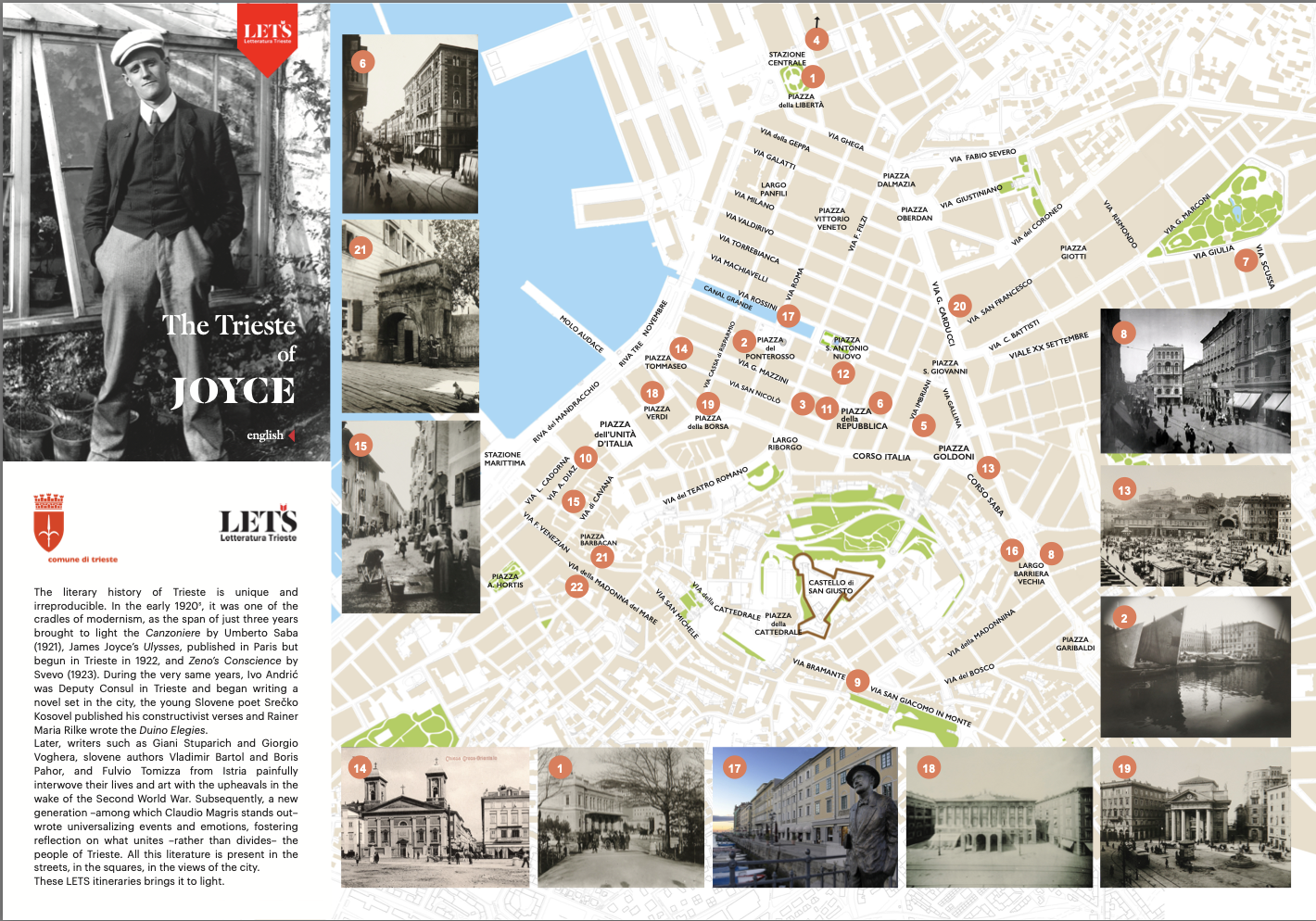
Map of Trieste from the official city website, tracing James Joyce’s presence in the city