
Syllabus
Syllabus
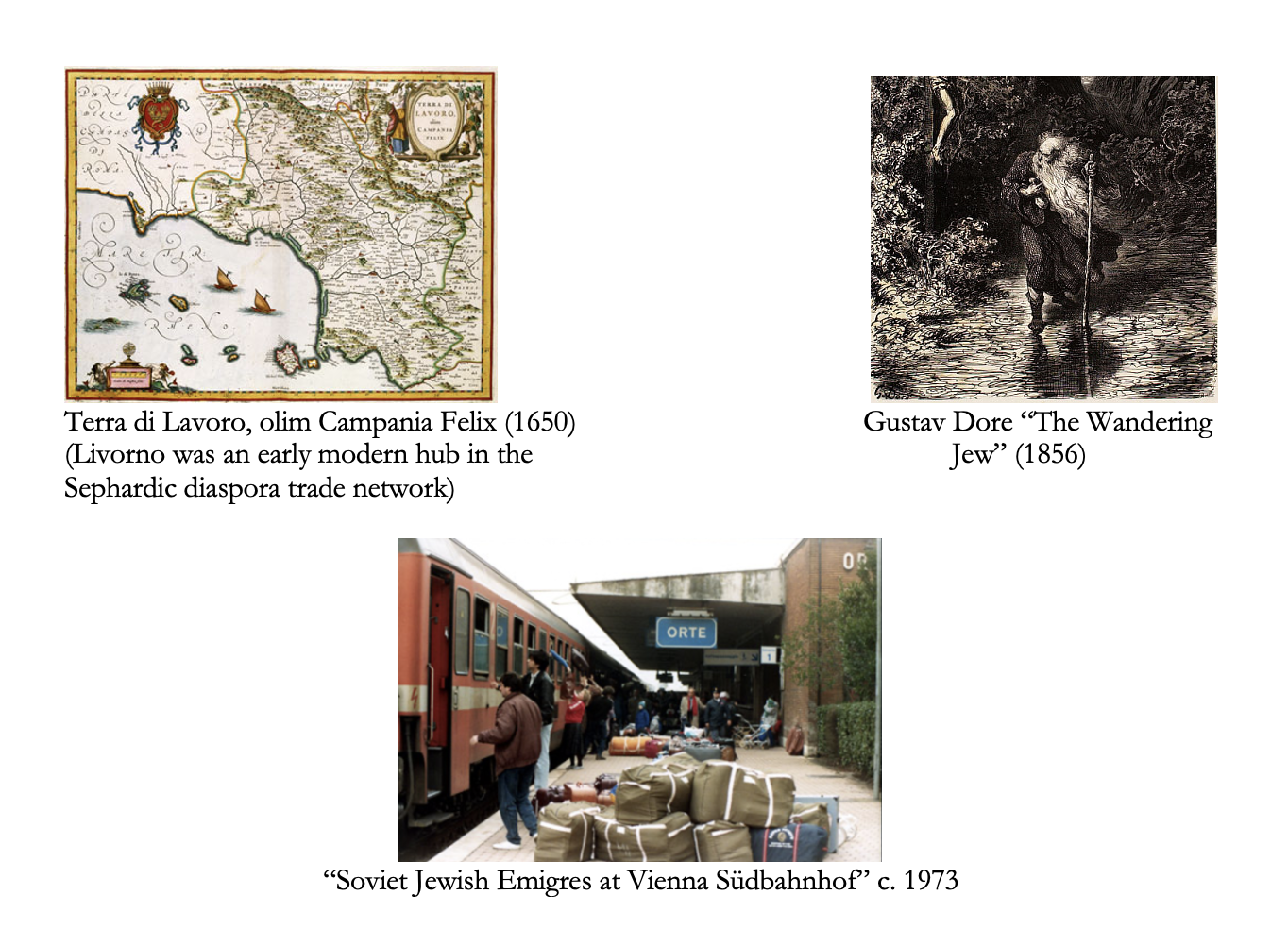
The trope of the “wandering Jew” emerged in Christian texts in the early thirteen century. Cursed to endlessly walk the Earth for taunting Jesus, the so-called “wandering Jew,” became a lasting emblem in artistic, literary, and historical portrayals of Jewish migration from the medieval period into the present. This icon, however, subsumed the rich and dynamic history of Jewish mobility, as Jews moved across the globe, and in the process, learned new languages, built enduring communities, and developed myriad identities.
This upper-level seminar, Mobility and Modernity: A Jewish History of Moden Migration, immerses students in the vibrant history of not only Jewish migration, but how Jewish mobility became intertwined with vital trends in international migration, ranging from the rise of mercantilist trade networks in the early modern period to the codification of international migration law in the mid-to-late twentieth century. Over the semester, students will follow Sephardi merchants who traversed the Mediterranean, working-class Jewish immigrants on the Lower East Side, and Holocaust survivors who confronted their newfound statelessness. Like their historical subjects, students will travel the globe, from seventeenth century Surinam to the Soviet Union. This seminar encourages students to ask incisive questions, as they deliberate the legal, social, and cultural history of not only Jewish migration, but global migration. What circumstances compelled Jews to move? How did migration place Jews in new political systems, power dynamics, and cultural milieus? And finally, how do narratives of Jewish movement enhance our understanding of provocative themes at the center of the history of migration, such as open borders, free trade, forced deportation, and assimilation?
Required Texts:
1. Carol Issacs, The Wolf of Baghdad: Memoir of a Lost Homeland (2020)
2. Leslie Page Moch Moving Europeans: Migration in Western Europe since 1650 (2003)
3. Primo Levi, Survival in Auschwitz, (1947)
This book can be purchased or accessed as an e-book. All other sources listed in the syllabus will be provided as scans by the instructor or as a purchasable coursebook. The instructor particularly recommends the latter, so students can locate their readings in one place, and therefore, more easily juxtapose them. The instructor also recommends that students purchase their chosen book for Paper 1.
Grading:
· Participation and Attendance (20%)
· Weekly Responses (20%)
· Museum Trip and Response (See Week 10 for assignment information) (15%)
· Paper 1 (20%)
· Final Project (25%)
FAQ:
What is your AI policy?
AI should not be used in any capacity for assigned readings or written course work. If I notice that you have used AI to create an essay, outline, or discussion post, I will schedule a meeting with you to discuss how I can better assist you with reading comprehension and writing practices. If I note continued use of AI after such a meeting, I will consider it a form of plagiarism and report it accordingly.
How can one do so much reading in so little time?
Every genre requires its own mode of reading. For a primary source, students will want to read with careful attention to detail in order to determine its historical value. For longer secondary sources, it is students’ responsibility to glean an author’s argument and evidence. As a result, a primary source reading that is merely one page long might take fifteen minutes, but a twenty-page secondary source article may take just forty minutes. You are always welcome to schedule a meeting with your instructor to develop the best reading practices for you.