
Trauma Informed Social Work - bmc.SOWK.B594.001.4W1.S24
Section outline
-
In this course, students will address key knowledge, values and skills that support trauma informed approaches to social work practice. Students will learn core concepts of trauma informed social work from an ecobiodevelopmental framework. This framework will assist students in understanding the impact of adversity and traumatic stress on health and wellbeing across the lifespan. Throughout the course, we examine how risk and protective factors shape the impact of traumatic stress on individuals, families, and communities. Connected to the strategic foci of the GSSWSR, this course builds on foundation level content in our curriculum, including an emphasis on power, privilege and oppression.
This course comprises key trauma-informed social work content and focus on the definition of trauma and traumatic stress, differentiating amongst levels of stress and clarifying unique elements of traumatic stress. In this course we also examine research on Adverse Childhood Experiences (ACEs) and how this work supports our understanding of how early life experiences of traumatic stress shape developmental and health outcomes across the life course. The interrelatedness of trauma and “intersectional” identity-based oppression – the accumulation of multiple forms of related subjugation (for example, based in racism, homophobia, transphobia, other gender-based oppression, and socioeconomic classism) that can cause and/or mediate traumatic experience, is also explored in this course. By taking this course students will be prepared to develop a grounding in assessing the trauma-informed capacity of their field agency, as well as for the promotion of trauma-informed principles in agency structure, policies, and in the organizational climate. Students will examine how cross-cultural perspectives on trauma are key to knowledge, values, and skills relevant to local and global models of social work practice. This builds upon a perspective of trauma that moves away from its conceptualization as a natural category to embrace the cultural and ecological systems that shape human experience and model ways of coping and meaning making. Additionally, this course explores pathways to trauma healing and particular implications for social work practice across system levels including Macro and Clinical Practice.
-
-
Opened: Friday, April 26, 2024, 12:00 AMDue: Friday, May 3, 2024, 12:00 AM
-
Opened: Wednesday, December 13, 2023, 11:00 PMDue: Thursday, June 20, 2024, 2:00 AM
The Class Participation Rubric is based on the GSSWSR’s Standards of Professional Behavior (as
outlined on pg. 35 of the student handbook: https://www.brynmawr.edu/sites/default/files/GSSWSR_Catalog_Web.pdf
13-15 Points
Fully prepared, attentive, always follows class guidelines, asks questions & makes comments in large or small group discussions; encourages & respects peers.
8-12 Points
Usually prepared, attentive, generally follows class guidelines, participates in asking questions and making comments regularly in large or small group discussions, encourages and respects peers regularly.
5-8
Preparation for class varies, generally follows class
guidelines, and doesn’t participate regularly by asking questions or making comments regularly, inconsistency with encouraging and respecting peers.
4 or less
Generally unprepared for class, doesn’t participate
consistently, or is disruptive or insensitive to others.
-
Opened: Friday, October 13, 2023, 12:00 AMDue: Thursday, June 6, 2024, 11:00 PM
Midterm Paper (30 points): Due Class 6: Thursday, June 6th at 11:59 pm EDT
Create a 3–4-page (AND NO LONGER) paper grounded in your experiences in a field setting (current or past field placement) utilizing APA 7th edition. This should include at a minimum four references. This assignment will be graded using the rubric provided in Moodle. Paper #1 is due Monday, June 6th at 11:59 pm EDT.
In the paper, engage with the following elements while considering the impact of trauma-informed care on your agency:
Introduction
· Provide a brief overview of your agency and its mission and goals.
Understanding Trauma within the Agency
· How do the mission and goals of your agency reflect an understanding of trauma?
· Define and describe individual and group-level sources of traumatic stress for clients within your agency.
Trauma-Informed Care Integration
· Define Trauma-Informed Care and describe how it fits within your agency.
· How does the organization seek to acknowledge the impact of trauma on clients and clinicians, and what practices, if any, are put forward to address these impacts?
Diversity, Difference, and Structural Inequities
· In what ways do your organization's practices and procedures reflect an awareness of diversity, difference, and/or structural inequities that shape clients’ experiences?
· What challenges do they experience in addressing these multiple layers of trauma?
Implementing Trauma-Informed Practices
· What steps can your organization take in implementing trauma-informed practices?
Policy Impact
· Are there policies, either within your agency or at the local, state, or Federal level, that are impacting the provision of services in your field setting? Discuss their implications for trauma-informed care within your agency.
Conclusion
· Summarize the key points discussed in the paper and propose potential strategies for further integrating trauma-informed care into your agency.
· Prompt for Reflection: As you reflect on your agency's practices and procedures, consider how trauma-informed care principles have been applied or could be further integrated. Reflect on the ways in which understanding trauma has shaped your approach to client care and organizational policies.
Ensure your paper adheres to the APA 7th edition guidelines for formatting and citation. PDF please.
-
Opened: Friday, February 2, 2024, 11:00 PMDue: Thursday, June 20, 2024, 2:00 AM
Final Assignment: Case Vignette Presentation (40 points): Due Class 10: Thursday, June 20th, at 9:00 am EDT
The final presentation will use content discussed throughout the semester to analyze aspects of the case vignette available on Moodle. Students will work in groups of 4-6 individuals (assigned by the instructor) to address the prompts below. Students are expected to present their assigned vignette orally to the instructor and the class. Each presentation should last no longer than 25 minutes and include a Q&A. Students are expected to upload their PowerPoint presentation to be used during their oral presentation on Moodle on or before the presentation.
The PowerPoint and oral delivery will be graded using the rubric located on Moodle.
All assignment requirements must be addressed clearly throughout the presentation. All group members MUST contribute to both the written and oral presentations. Presentations for which the area/idea being discussed is unclear will affect your overall grade.
· Your presentation should be formatted to meet APA 7th formatting guidelines
· A reference page, formatted to meet APA 7th edition standards, should also be included, which includes all citations used throughout your document.
Case Vignette Presentation Prompts:
1. Introduce the case by describing social identities and other influential biopsychosocial components of development and family context, the strengths, and the presenting problem(s) of your case vignette: Jack, Samuel, Dinah, or Paloma.
2. Identify a definition of trauma in the readings and use that specific definition to identify the traumatic experiences of your case vignette. Jack, Samuel, Dinah, or Paloma.
3. Using the EcoBioDevelopmental model, describe factors associated with individuals' and communities' paths to risk and resilience in response to the traumatic experiences of your case vignette: Jack, Samuel, Dinah, or Paloma.
4. Consult on a possible intervention for treatment:
o Identify the presenting problem you would first address with the client.
o Suggest an intervention you would use and the reason for selecting it based on the specific presenting problem of your case vignette: Jack, Samuel, Dinah, or Paloma.
o Describe the intervention in detail (explain the pros and cons of this intervention and include cultural considerations or adaptations).
· Examples of approaches to consider (NB: this is not an exhaustive list): Cognitive processing therapy (CPT), Trauma-Focused Cognitive Behavior Therapy (TF-CBT), Eye Movement Desensitization and Reprocessing (EMDR), Animal-assisted therapy, Neurofeedback/biofeedback, trauma-sensitive yoga, Indigenous healing practices, Trauma Recovery and Empowerment Model (TREM; this is a group intervention model), brief psychodynamic, Music Therapy.
-
-
-
-
-
-
This course includes content (e.g., readings, videos, and discussions) regarding issues that might be triggering for some. A trigger may be something as simple as one word or image, or more complex, like a detailed description of a violent act. While I cannot always predict what will be triggering to a specific student in class, I will do my best to identify potentially upsetting material for you. However, given the nature of this course and each student’s different needs, kindly ensure that you take the necessary steps to recognize your triggers, and how best to ground yourself (e.g., focus on pleasant sights, sounds, smells, tastes, and touch, take slow, deep breaths, think about a happy or comforting memory). You are always welcome to excuse yourself from an uncomfortable discussion, take a bathroom break, or give yourself time to calm your emotions and collect your thoughts.
In the event you become distressed or feel overwhelmed, please note that BMC has a counseling center. Please ensure that you utilize the various resources available to you at BMC's Health Center located at 101 North Merion Avenue, 610-526-7360 (https://www.brynmawr.edu/healthcenter/counseling-se). As a currently enrolled BMC student, you can meet with a counselor for a 30-minute brief assessment. During this meeting, the student and counselor will discuss the student's needs and identify a range of options best suited to meet the stated needs. To speak to a counselor when the Health Center is closed, call: 610-526-7778.
Lastly, our Student Services team, Marcy Nyachago and John Edwards, are available to meet with students to provide individualized support and share available resources. He also supports student organizations, student government, and community-building events like Community Conversations and Open Dialogues. You can contact them at mnyachogo@brynmawr.edu or jjedwards@brynmawr.edu.
-
As we embark on a new semester, these are the agreed upon class guidelines. They are placed here as a reminder to both the professor and students as to the expectations regarding how we communicate and interact with each other throughout the semester.
1. Participate as you can
2. Check-in with yourself, stay attuned to your needs, and ask for what you need.
3. Provide trigger warnings as possible
4. Confidentiality-the Vegas rule
5. Allow space for each of us to grow
6. Active listening
7. Validation
8. Assume good intent/positive regard for client
9. Recognize impact
10. Silence is okay
11. Lean forward/lean back
12. Open minded/I statements/Yes, and
13. Mindful sharing
-
Group 1 (Jack):
Gabe Adels Lily Alexander Breanna Brown Jay Dahlke Group 2 (Samuél):
Nicole Daly Sarabeth Davis Romelia Guerrero Shazia Iftkhar Group 3 (Dinah):
Meryl Lammers Caroline Lu Ciaira McFadden Adrianna Morales Group 4 (Paloma):
Yasmeen Rice Devorah Scheiner Sarah Sidoti Laura Smith Group 5 (Jack):
Sam Spirt Shelby Statham Samantha Sternberg Abbey Stewart -
Class 1: Course Introduction
Topics
• Review of course modules, assignments, and guidelines for classroom discussion
• Planning for self-care and the Professional Quality of Life (PROQOL)
• Introduction to grounding techniques
• Introduction to trauma and vicarious trauma
Readings and Multimedia:
• Rosman, K. (2023). Should college come with trigger warnings? At Cornell, it’s a hard no. New York Times
• Lipsky, L. V. D. (2009). Trauma Stewardship. Berrett-Kohehler, Publishers, Inc: San Francisco, CA. [Chapters one and three].
Supplemental Readings:
• Centers for Disease Control (2020). Coping with stress during a pandemic.
• Ginwright, S. (2018). The future of healing: Shifting from trauma informed care to healing centered engagement.
-
Week 2: Exploration of Core Concepts & Review of the EcoBioDevelopmental Model, and the Human Development and Stress Theory
Class 2: Core Concepts: The EcoBioDevelopmental Model, Human Development, and Stress Theory
Topics
• Review of the EcoBioDevelopmental Model
• Adverse Childhood Experiences (ACEs)
• Differentiation of types of stress: Positive, Tolerable, and Toxic Stress
• How unmediated stress impacts early development
• Trauma in the context of development across the life course
o Types of traumatic stress: Acute, Chronic, and Complex Traumatic Stress
o Impact of traumatic stress on indicators of wellbeing across the lifespan
Readings and Multimedia
· Shonkoff, J., Garner, A., and the Committee on Psychosocial Aspects of Child and Family Health (2011). The lifelong effects of early childhood adversity and toxic stress. Pediatrics, 129(1). doi: 10.1542/peds.2011-2663
· National Childhood Traumatic Stress Network (2018). Effects of complex trauma.
· Watch YouTube Video on the EcoBioDevelopmental Model (on Moodle Site)
· Center for the Developing Child (2014). Excessive stress disrupts the architecture of the developing brain. National Scientific Council on the Developing Child. Working Paper #3.
· Trauma Screening (Child Interview):
· Trauma Screening (Parent Interview):
Grounding Technique Facilitation Activity
-
Students mustMark as done
-
-
This video provides an overview of the EcoBioDevelopmental Model.
-
This video documents the adverse life experiences and healing of Tonier Cain.
-
This video demonstrates how clinicians can screen children for trauma.
-
-
-
Class this week is asynchronous.
Topics
• Trauma-informed organizations: Guiding principles
• Reflection on TIC and your agency. SAMHSA (2014).
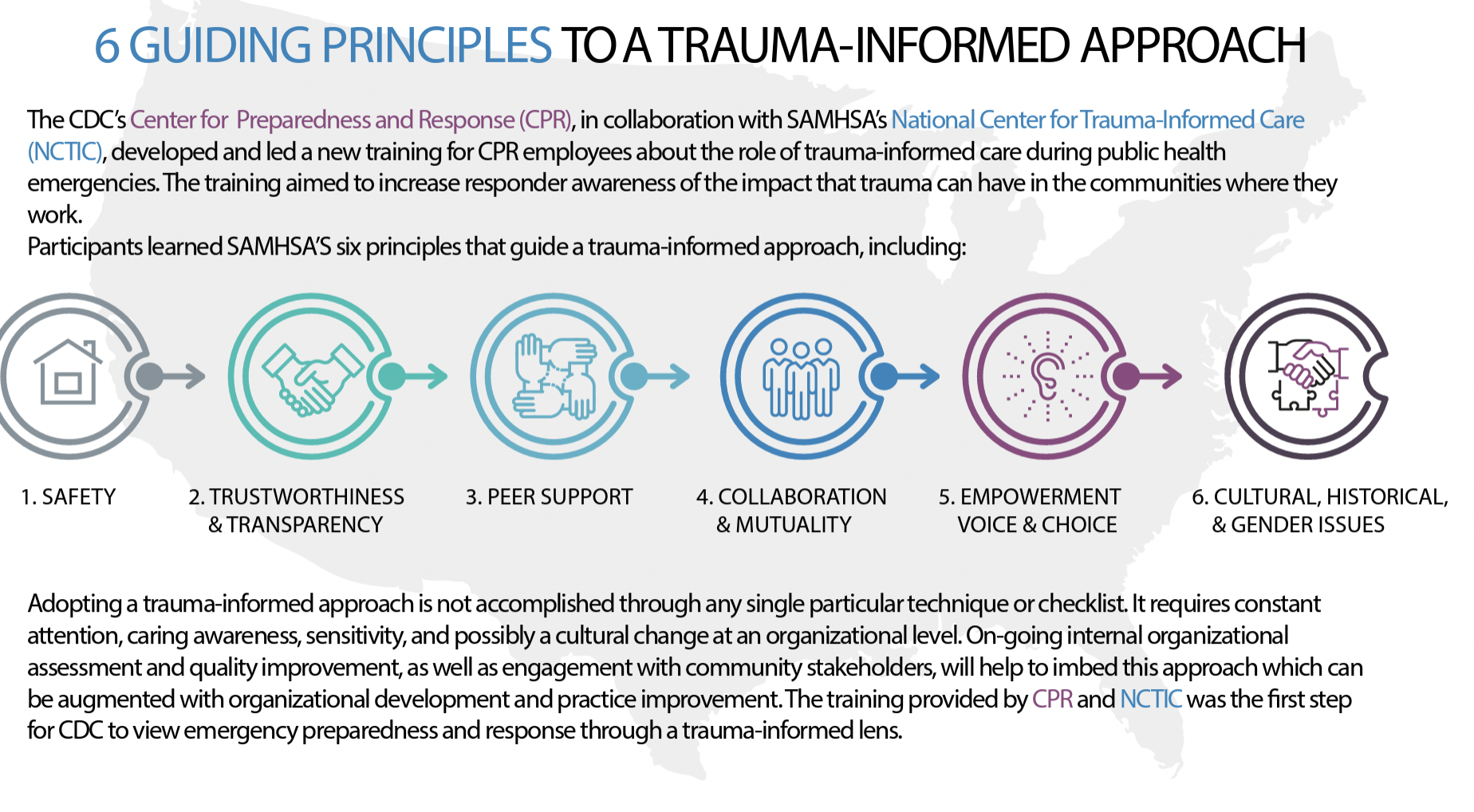 This brief video features a SANE nurse talking about trauma-informed principles. It contains references to sexual assault and domestic violence. She does an excellent job of summarizing the ripple effects of trauma and how organizational members can partner to support traumatized people.
-
Students mustMark as done
-
Topics
• The impact of trauma on systems
• Signs and symptoms of traumatized systems
• Assessing organizational health and traumatization
• Implementation of trauma-informed principles
Required Readings and Multimedia
• Bowen, E. & Murshid, N. (2016). Trauma-informed social policy: A conceptual framework for policy analysis and advocacy. Perspectives From the Social Sciences, 106(2), 223-229.
• Brisson, D., Holtzinger, C., Macur, R., Rossbert, L., Speer, S. R., & Wilson, J. (2023). Designing for healing, dignity, and joy: Iterating on the Trauma-Informed Design Framework (V.2). Shopworks Architecture, Group 14 Engineering, University of Denver Center for Housing and Homelessness Research, and Bryn Mawr College.
• Harris & Fallot. (2001). Envisioning a trauma-informed service system: A vita paradigm shift. New Directions for Mental Health, 89, 1-22.
Grounding Technique Facilitation Activity
-
Topics
• The Stress Response System: The HPA Axis
• Neurodevelopmental impact of chronic activation of the stress response system
• Allostatic load and epigenetics
• Neurodevelopmental mediation of early adversity and pathways for risk and resilience
• Small Group: Mid-Term Paper Review Activity (2:00-3:00 PM)
Readings and Multimedia:
• NIMH (2018). Brain Basics.
• Berens, A. E., Jensen, S. K. G., & Nelson III, C. A. (2017). Biological embedding of childhood adversity: From physiological mechanisms to clinical implications. BMC Medicine, 15, 135. doi: 10.1186/s12916-017-0895-4
• Bruce, L. (2005). The biology of belief: Unleashing the power of consciousness, matter and miracles. Santa Rosa: Elite Books. 31-43.
Supplemental Readings:
• Shapiro, J. & Applegate, J. (2018). The neurodevelopmental impact of stress, adversity and trauma: Implications for social work with vulnerable parent-child dyads. In Shapiro, J. & Applegate, J., Neurobiology and Clinical Social Work.
• Bernard, K., Hostinar, C. & Dozier, M. (2015). Intervention effects on diurnal cortisol rhythms of child protective services referred infants in early childhood preschool follow up. JAMA Pediatrics, 169(2), 112-119. doi:10.1001/jamapediatrics.2014.2369
Watch: Bruce Perry Slides on Brain Development and Toxic Stress
-
-
Students mustMark as done
-
-
-
Topics
• Trauma and intersectionality
• Identity-based oppression
• Trauma and identity-based oppression across systems (juvenile justice, education, and mental health)
Required Readings and Multimedia
• Alessi, E. J., & Martin, J. I. (2017). Intersection of trauma and identity. Trauma, resilience, and health promotion in LGBT patients: What every healthcare provider should know, 3-14.
• Nadal, K. L. (2018). Concise guides on trauma care series. Microaggressions and traumatic stress: Theory, research, and clinical treatment. American Psychological Association. [Chapter 1]
• Smith. C. (2019). Intersectionality and sizeism: Implications for mental health practitioners. Women & Therapy, 42 (1-2), 59-78. https://doi.org/10.1080/02703149.2018.1524076
Supplemental Readings:
• Kendi, I. X. (2020). Stop blaming Black people for dying from the Coronavirus.
Grounding Technique Facilitation Activity
-
Topics:
• Collective and historical trauma
• Social factors that impact trauma recovery
• Collective trauma in marginalized communities
• Social work practice with traumatized and marginalized communities
• Cross-cultural approaches to trauma
• Languages of distress and models of coping
Required Readings and Multimedia
• Schroeder, K., Noll, J. G., Henry, K. A., Suglia, S. F., & Sarwer, D. B. (2021). Trauma-informed neighborhoods: Making the built environment trauma-informed. Preventive Medicine Reports, 23(2021), 101501.
• Alessi, E. (2014). A framework for incorporating minority stress theory into treatment with sexual minorities. Journal of Gay and Lesbian Mental Health, 18(1), 47-66.
• Patel, A. R., & Hall, B. J. (2021). Beyond the DSM-5 diagnoses: A cross-cultural approach to assessing trauma reactions. Focus, 19(2), 197-203.
• Hinton, D. E., & Lewis-Fernández, R. (2011). The cross-cultural validity of post- traumatic stress disorder: Implications for DSM-5. Depression and Anxiety, 28, 1-19.
-
Class 8: Pathways to Trauma Healing: Trauma-Focused Modalities. Asynchronous Content and Group Meeting Time
Topics
· Introduction to some trauma-focused interventions (CPT, EMDR, SE)
Required Readings and Multimedia
• Lipsky, L. V. D. (2009). Trauma Stewardship. Berrett-Kohehler, Publishers, Inc: San Francisco, CA. [Chapter Four]
o Reflect on any trauma exposure responses that might be potential burnout warning signs for you.
• Somatic Experiencing:
o Visit the SE website: https://traumahealing.org/
o Watch the following related video on Kanopy (55 minutes). Body-Oriented Therapy Sessions II: Somatic Experiencing Therapy. https://www.kanopy.com/en/brynmawr/video/120767
• EMDR
o Visit the EMDRIA website: https://www.emdria.org/about-emdr-therapy/experiencing-emdr-therapy/
o Read the overview of experiencing EMDR Therapy and watch the video on the webpage (5 minutes).
?• CPT
o Visit the website: https://cpt2.musc.edu
o Watch the following related video on an Introduction to CPT (22 minutes). https://www.youtube.com/watch?v=EBMuIw5kjCk&t=1074s
Small Group Meeting: In addition to the required asynchronous content, please use this time to meet with your small group and prepare for the final presentation due on Thursday.
-
-
Students mustMark as done
-
-
-
Topics
• Best practices
• Common factors
• Triphasic model of trauma treatment
• Creating safety
• Trauma processing
• Reconnection
• Clinical considerations
Required Readings and Multimedia
• Zaleski, K. L., Johnson, D. K., & Klein, J. T. (2016). Grounding Judith Herman’s trauma theory within interpersonal neuroscience and evidence-based practice modalities for trauma treatment. Smith College Studies in Social Work, 86(4), 377-393.
• Briere, J. & Scott, C. (2013). Principles of trauma therapy: a guide to symptoms, evaluation, and treatment, 2nd edition. Sage Publications: Thousand Oaks, CA. [Chapters 4 and 5]
• Van der Kolk. (2014). The body keeps the score. New York: Penguin, 205-231.
• Briere, J. & Scott, C. (2013). Principles of trauma therapy: A guide to symptoms, evaluation, and treatment, 2nd edition. Sage Publications: Thousand Oaks, CA. [Chapter 6]