
Modern vs. Postmodern
1) Although I personally find the discourse about senses the most interesting, I have more questions about the division number fifth, which is "object of collection". My first intuition here was that in the modern times, it was a particular individual who, by demonstrating a certain peculiar characteristic (being a threat for the government, a reason for the local gossip, etc.), was surveilled. In the postmodern times, however, everyone is surveilled, and the individual peculiarities do not matter as much, for everyone—as if in a soulless marketing study with its "customer groups" and "target audiences,"—is a part of some group and being tracked accordingly. This way, a person, invisibly for themselves, is being attributed to a category that, presumably, dictates their preferences, habits, and interests. So, in the modern times, a person A. would be watched because they present something of interest in themselves; it could also be as being a part of some group (for example, a foreigner)—but it will be the individual who is the end of the act of watching; not in terms of agency or personhood, but in terms of them radiating this very characteristic. An example from the work of my choice would be the short story It Had to Be Murder by Cornell Woolrich: the protagonist is watching his neighbor because of the curiosity in the life of this individual. In the postmodern times, however, a person B., being an immigrant, is a part of the category the surveilling machine is "keeping the tabs" on—an atom in a giant structure. Any information that is being obtained about this person B. contributes to the understanding and subsequent control about immigrants, the category the person B. belongs to. It seems to me that it is the postmodern society that proclaims individuation as contrary to the modern culture which embraced the higher goal of serving the society—and yet we see the surveilling mechanisms mirroring each other.
Lavater
2) On the page 45, the second objection suggests the danger of suspicion and inspection following "the unblessed art of judging [one's] brother by the ambiguous expressions of his countenance". It strikes me in the connection with Lavater's distinction between physiognomy and pathognomy, where the latter is "the knowledge of the signs of the passions," (12) meaning the observation of one in motion. The second objection I have just provided makes me think about the role of facial expression, the affective product of motion, conscious or not, in the immediate, natural judgement of person we acquire by just looking at them. I believe that most of the speculations we might have when seeing someone comes from their emotions and mental—rarely moral, unless someone smiles in a highly inappropriate setting,—state making their way through the facial muscles, but not the innate (except for, of course, cases of the primitive traits-specific judgement, similar to that of Lavater) facial build. The intuition showering us as the first impression of facing someone might be coming through the signals other than facial features and even expression.
Actors are able to fake "twinkling eyes," and people in the professional settings smile and fake compassion ("I am sorry; thank you for sharing" while thinking "Why are you telling me that? I want to go home") convincingly. Some cultures are known as more hostile based on the circumstantial, not constant, habit of smiling. Some people with so-called "hooded eyes" tend to always keep their eyebrows slightly raised, for doing the opposite might harm their social relations, as it would project them as "unfriendly" and "gloomy". Motion definitely affects the perception of one's face (and one can use it at their advantage, to avoid seeming intimidating or to mask natural feelings), and it is no-win game to attempt to define who is sincere and who is acting, and what the vagueness . Also, given the vagueness of the cryptic display called "face" (some people's face might not show a smile when they feel joy, while other's mouth corners will go down instead of the opposite direction), it is as if facial expressions were a language unique to each individual, and using a different framework to discern them would be compared to using an English dictionary for reading German—even though both use the Latin characters.
3) The figures 8, 9, and 10 on the page 514.
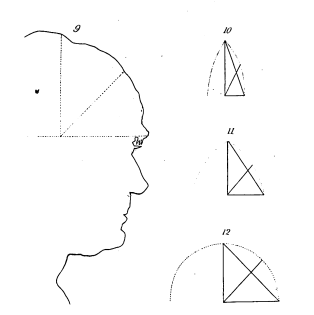
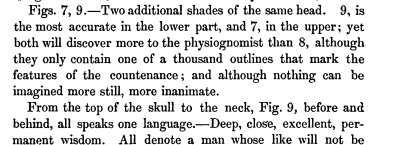
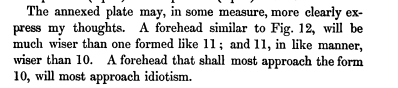
When reading the introduction, I made an annotation on the page 9: I wrote "golden ratio," as provoked by Lavater's stubborn belief in "the congeniality and harmony". This aim of his reminded me of the historical attempt to standardize a human's body in order to achieve perfection—as ideal as possible, as representative of the divine as could be allowed. Is it so far from our contemporary thought, however? These drawings I have clipped above strongly remind of the ubiquity of plastic surgery that dissects the face—both literally and figuratively, by giving the names and standards to the proportions and features that go beyond a humble descriptive quality.


P.S. I found a (obviously insulting) note on the ethnicity that happens to be a half of me: "more material and gross Tartar"! Such a rarity to see a mention of it in my class reading.
P.P.S. 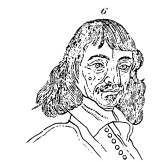

Page 453: he seems to really deslike Descartes...