
- I struggled with these differentiations in class so I may need more of an explanation before I answer this question.
- In one of the definitions Lavater gives, he describes Physiognomy as "the science or knowledge of the correspondence between the external and internal man," which can also be looked at as what he believes to be a relationship between visible vs invisible (11). Put simply, the visible physical/external qualities of a person's countenance speaks to invisible, internal qualities which he doesn't explicitly name. One of his arguments for practicing Physiognomy is also one of the things (I believe) he believes is an advantage of the "science." He argues that every human being already relies on instinctual physiognomic sensations- aka, observations. He says later on page 17,
nor is there a man to be found on earth who is not daily influenced by physiognomy ; not a man who cannot figure to himself a countenance which shall to him appear exceedingly lovely , or exceedingly hateful ; not a man who does not more or less , the first time he is in company with a stranger , observe , estimate , compare , and judge him , according to appearances (17).
He argues that people already make connections and assumptions about people's characters, even babies ("each child loves and fears although it knows not why," 17) which he uses to suggest that this ability to read people by their appearances is one of man's biological skills and therefore should be studied and used. I don't know which disadvantages he brought up because it seemed like he was defending the practice through and through.
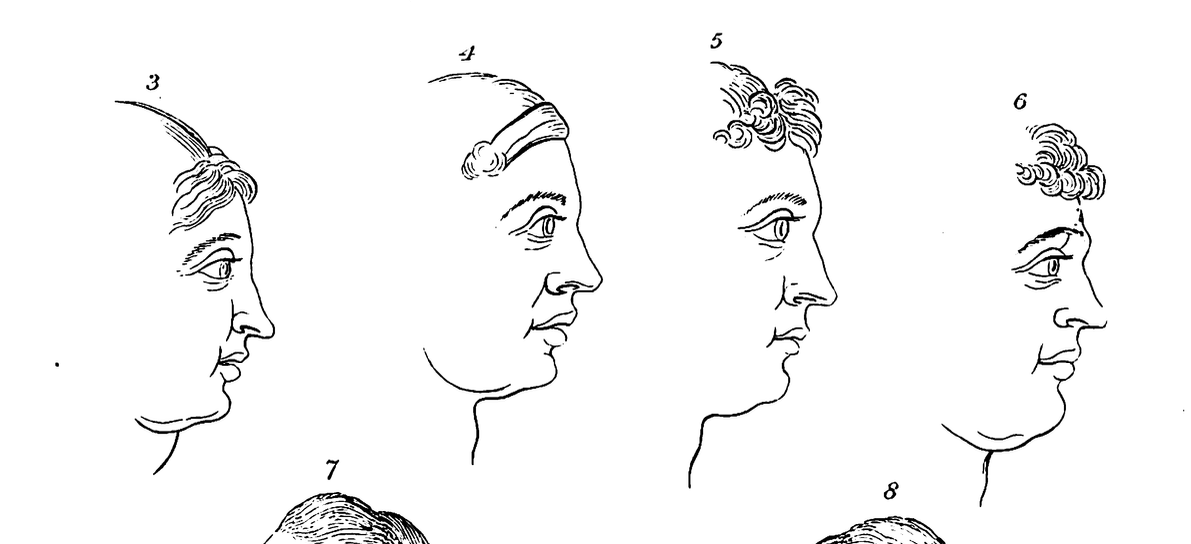
3. I found it interesting whenever Lavater brought up Greek or Roman art (and especially the portrait of Judas from our reading) because he reads these images as if they can be taken seriously for a real human's countenance. Even though at the beginning of the reading he does acknowledge that even the most beautiful grecian statue is not as beautiful as God (this is during his theological rant that man was made in God's image on page 3), he still seems to put these countenances either in high esteem or ridicule them (as is the case for Judas). On plate 5 (just before page 59), he includes the drawings of four statues, not real people. I'm confused what he means to say about these faces, especially when they do not exist as humans. He seems to want to use Physiognomy to determine someone's moral character but one can't do that to a statue. Therefore, it seems that his argument already begins to concern itself more with beauty and what he/we consider beautiful, not necessarily what we consider to be moral.
4. One of the questions I had for him was related back to something he said about Nature (page 6). He seems to argue that Nature creates impressions on people- but how does Nature decide which impression or features to make and when do those impressions occur?