
ESEM007 - Wonders of Italy
Section outline
-
My name is Professor Federico Sessolo (pronouns: he/him) and I will be your teacher this semester.
I grew up in Venice, Italy, and obtained a Ph.D. from Scuola Normale Superiore di Pisa. My area of specialization is transnational twentieth-century literature and cinema.
This is my first time teaching an Emily Balch Seminar, and I am really excited to be a part of the most defining experience for first-year students at Bryn Mawr College.
My office hours are Wednesday, from 2 to 3 pm, or by appointment. My office is in Old Library, 247.
Before we start: The Department of Transnational Italian Studies hosts several events (in English) throughout the year. Please remember to follow us on social media to catch every update!
-
-
Please remember that the syllabus is a work-in-progress document and may be subject to changes throughout the semester.
-
-
-
-
Your professor will upload PPT presentations here.
-
-
-
Let us start by appreciating the tradition of the Emily Balch Seminars, one of the most defining experiences at Bryn Mawr College.
We will then discuss the syllabus, the workload, and your expectations about this course.
Finally, a few notions about Italy’s history and geography.
-
How can you build a city out of a bunch of rocks and muddy islands? We will delve into the crazy history of Venice to understand why the city has attracted so many visitors over the last five centuries.
We will d also discuss how the myth of Venice took shape in literature and how it has impacted contemporary tourism.
-
Like many other UNESCO sites, Venice is undergoing massive challenges, including overtourism and the rising of sea levels. We will follow several acclaimed essayists and scholars to find out their opinions about it.
-
-
Opens: Tuesday, September 15, 2026, 8:00 AMDue: Sunday, September 20, 2026, 11:59 PM
-
Did you know that Genoa’s former mayor sued the British royal family for (allegedly) stealing the city’s flag? This is only a minor example of the long history between the English/American mind and the city of Genoa, a major harbor in the Western Mediterranean.
This week, we will also watch a movie to reflect about the Disneyfication of Italy.
-
Now a marginal city, Trieste was once the center of several worlds: until 1918, it was the most important port of the Austro-Hungarian Empire; in 1945, it became the final station of the famous iron curtain imagined by Winston Churchill (the other point being Stettin, in the Baltic Sea).
Trieste shows us how space and time can intertwine in sinister and paradoxical ways. We will discuss the notion of “national identity” and link the history of Trieste to the present day.
-
The city of Florence has historically been one of the most favorite destination of American tourists, and more specially female college students.
This week, we will visit the Special Collections at Bryn Mawr College's library.
-
Someone would argue that Rome is nothing but a bunch of cities under a trenchcoat. Let’s see what English-speaking travelers have to say about it.
More seriously: What are the challenges of Rome today? What can we say about its population and services?
-
We follow some English-speaking travelers as they journey through Calabria, historically one of the most under-developed regions in Italy.
-
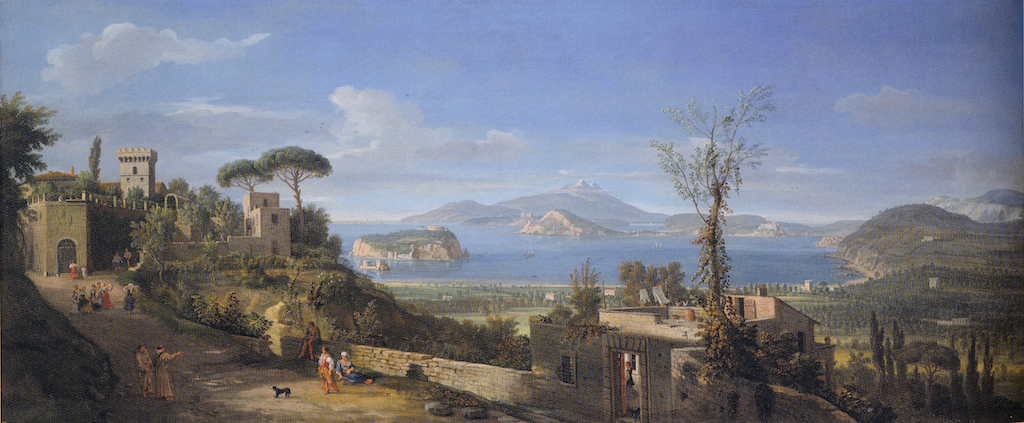
Naples is a complex city with a centuries-long history. Let’s see how its British and U.S. perception has changed over the last 100 years.
We will also discuss the ethics of poverty tourism.
-
The biggest island in the Mediterranean Sea also possesses a rich and convoluted history. We will compare two texts that appeared roughly around the same time, portraying the country in two very different ways.
This week, we will also watch the movie The Mafia Kills Only in Summer by Pif (2013)
-
The second-biggest island in Italy is also one of the least regions abroad. Apart from the super-luxury playground at Costa Smeralda, much of Sardinia has remained secluded throughout the centuries. But things are starting to change.
-
The Alps are often referred to as “the heart of Europe” because ten different countries share them. We will study how the Alps have been politicized through the decades, from WWI nationalism to the No-Tav activism in Val di Susa.
-
We will work collectively to draft the history of tourism from its eighteenth-century beginning from the contemporary world.
-
This week we will study how the perception of Italy has been fostered and modified by influencers and generally social media.