
34 - Josephine Van Kouwen, Niels Y. Vink, "TikTok Queues in Tourism" (2026)
34 - Josephine Van Kouwen, Niels Y. Vink, "TikTok Queues in Tourism" (2026)
1. TikTok queues in tourism
Pleuni Josèphine Van Kouwen  and Niels Yuri Vink
Erasmus School of History, Culture and Communication, Erasmus University Rotterdam, Rotterdam, PA, The Netherlands
ARTICLE HISTORY
Received 18 August 2025
Accepted 26 March 2026
KEYWORDS
Overtourism; attractiveness; authenticity; norms; regret; videos
Introduction
In recent years, short-form video platforms, such as TikTok, have emerged as influential drivers of tourist attention, destination awareness, and travel decision-making. Characterised by algorithm-driven content distribution, immersive audiovisual storytelling, and rapid viral diffusion, TikTok has transformed how tourism information is produced, consumed, and evaluated. Tourists want to record and share their wonderful journeys by creating public diaries and sharing them with
CONTACT Niels Yuri Vink  vink@eshcc.eur.nl
© 2026 The Author(s). Published by Informa UK Limited, trading as Taylor & Francis Group
This is an Open Access article distributed under the terms of the Creative Commons Attribution License (http://creativecommons.org/licenses/by/4.0/), which permits unrestricted use, distribution, and reproduction in any medium, provided the original work is properly cited. The terms on which this article has been published allow the posting of the Accepted Manuscript in a repository by the author(s) or with their consent.
others (Du et al., 2022). Such tourism videos increasingly shape tourists’ perceptions through emotionally engaging visuals, narrative structures, and background music (Zhang et al., 2025).
Furthermore, these social media videos are also claimed to cause so-called TikTok queues, which may emerge because of the popularity of TikTok videos for specific tourist places. Because of these TikTok queues, cities face the challenge of modern tourism policy, which is to create a balance between economic and cultural benefits, and the sustainable management of visitor flows (Tarasiuk et al., 2025). Without this balance, destinations experience overtourism problems, which lead to the loss of local identity, local individuality, and local facilities (Dhiraj & Kumar, 2021). Although TikTok queues may bring economic benefits, they may also lead to overtourism.
In addition, TikTok can cause problems in the tourism sector because tourists may get the wrong impressions of tourist places. Du et al. (2022) showed that tourists value the beautification tools that TikTok enables to present idealised footage, such as a beautified tourism experience. This is a problem since this beautified footage can be misleading, and therefore, tourists may form more posi-tive perceptions of a certain tourist place than it actually is in reality.
Effective responses to overtourism require a thorough understanding of its underlying causes. So, the relevant question is: what makes tourist places so attractive to tourists? A combination of per-sonal (perceived authenticity, anticipated regret), social (social norms) and digital factors (social interactions, informativeness and trust in social media videos) may affect the attractiveness of a tourist place.
A first factor may be tourists’ perceptions of the authenticity of a tourist place. Tourists often seek authentic experiences when travelling (Shi et al., 2022). Although tourists may perceive certain tourist places as authentic, residents may not view these places as authentic to their culture. So, per-ceptions of authenticity may increase the attractiveness of a tourist place (perceived authenticity).
A second factor may be that people tend to copy the behaviour of others. The choices of other people are usually a good source of information for our own choices. So when many people are visit-ing these tourist places, others should do so as well (Wasaya et al., 2022). This makes tourist places with many tourists in queues likely to be perceived as attractive (social norms).
A third factor may be the dilemma that tourists are always facing: do they visit a tourist place where they know exactly what to expect? Or are they going for a more uncertain experience without expectation? After all, they cannot visit all tourist places; they have to make choices. They may feel regret if they fail to visit tourist places of which they have high expectations (Chorus, 2014). On the other hand, they may not feel regret if they fail to visit tourist places of which they have low expectations (anticipated regret).
The final factor that was investigated is the effect of social media videos on popular platforms. Social media, particularly TikTok and Instagram, has been shown to exacerbate overtourism by sti-mulating travel demand through visually appealing content (Tarasiuk et al., 2025). TikTok users generally demonstrate a strong interest in travelling, making the platform influential in travel decision-making (Zhou et al., 2023). Such content spreads rapidly, shapes tourists’ perceptions and experiences, and increases the perceived attractiveness of destinations, often without consider-ation of destination capacity, thereby intensifying pressure on already crowded places (Du et al., 2022; Tarasiuk et al., 2025; Wengel et al., 2022) (social media videos).
Our study specifically investigated the effects of the four motivations on the actual behaviour of tourists visiting tourist places. This is in contrast with most studies, where the focus is on examin-ing tourists’ intentions (Fong et al., 2025; Shi et al., 2022; Wang et al., 2023; Wasaya et al., 2022). Studying intentions has the disadvantage that people do not always do what they intended, which may reduce the validity of these studies, because people may not actually perform the intended behaviour (Sheeran, 2002). This study looks at actual behaviour in order to provide more valid insights into the mechanisms that are related to visiting attractive food places. Insight into these mechanisms can help social media managers actively manage the perceived attractiveness of tourist places.
Theoretical framework
There is research about tourists using social media videos (Wengel et al., 2022). Other studies show how social media can cause overtourism (Dhiraj & Kumar, 2021). There is also research about how authenticity is related to tourism (Ram et al., 2016). However, there is no research to date about the combined effect of perceived authenticity, social norms, anticipated regret, and social media videos on perceived attractiveness of tourist places that are useful for destination-management organisations (DMO’s), and policymakers of municipalities (see Figure 1).
Perceived attractiveness
Perceived attractiveness is about the positive feelings, beliefs, and thoughts that tourists have about a destinations’ perceived ability to satisfy their travel needs. The higher the perceived attractiveness of a tourist place, the higher the chance is that it will be visited (Szubert et al., 2022).
According to Kim (1998), there are six factors that contribute to perceived attractiveness for tourist places. These are (1) seasonal and cultural attractiveness, (2) a clean and peaceful environ-ment, (3) quality of accommodations and relaxing facilities, (4) family-oriented amenities and safety, (5) accessibility and reputation, and (6) entertainment and recreational opportunities.
In order for a tourist place to be seasonally and culturally attractive, it should provide a unique experience, be fun while sightseeing, and offer a cultural experience. One of the authors visited Uluru (formerly known as Ayers Rock) in the Northern Territory of Australia not too long ago. This site scores high in this category since it provides a unique experience, the sightseeing of the rock is fun, and it offers a cultural experience at one of the oldest landscapes in the world.
A clean and peaceful environment also contributes to the perceived attractiveness of a tourist place. The place needs to be quiet and peaceful, but it should also be clean and include sanitation. In addition, the place needs fresh air and clean water. And finally, it needs reasonable prices. When one of the authors was visiting Uluru, she noticed that the area was quiet, peaceful, and well-
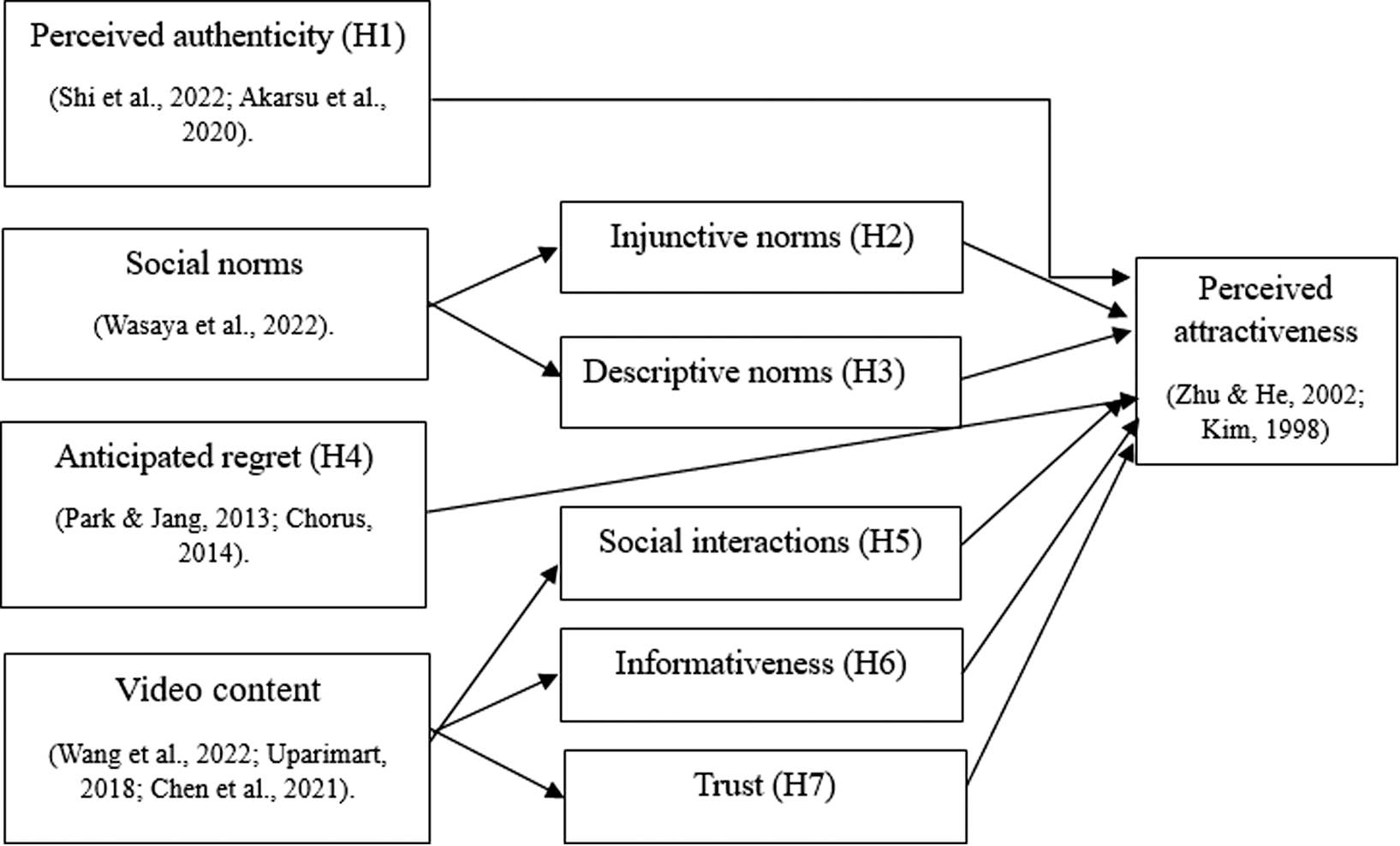
Figure 1. Conceptual research model.
maintained. It also provided access to sanitation, had fresh air, and access to clean water. The nearby resort offered various accommodation types, which made it affordable for everyone.
The quality of accommodations and relaxing facilities contributes to the perceived attractiveness in three ways. The most important one is the availability and quality of accommodations. Furthermore, the tourist place should have resting and relaxing facilities, in addition to a variety of types of food and beverages. The resort close to Uluru consists of various accommodations that have their own shops and restaurants. They all cooperate as the village of Yulara.
Perceived attractiveness also benefits from family-oriented amenities and safety. This refers to the suitability for families with children, the safety of the place, and the experience of a new and different lifestyle with others. Uluru is a safe place to visit, even for families with children. In addition, when visiting the rock during a group tour, people learn and experience the lifestyle of the aboriginal tribes that live in the area.
The perceived attractiveness of tourist places is also enhanced by accessibility and reputation. Accessibility relates to the convenience of getting to the tourist place in terms of traffic and location, whereas reputation is about the image of the tourist place. Uluru is not easily accessible since it is located in the outback of Australia. One must arrive by plane, or by a long road trip by car or bus. However, Uluru has the reputation of a must-visit when travelling in Australia.
Finally, entertainment and recreational opportunities contribute to perceived attractiveness. These are related to the availability of nightlife and entertainment, the scenery and landscape, and sports and rec-reational opportunities. In the Uluru area, there is a lack of nightlife, but lots of entertainment. For instance, there are aboriginal art workshops, but also recreational opportunities such as a swimming pool. The scenery and landscape are magnificent because it is not like any other place in the world.
A tourist place is not likely to score high on all these factors simultaneously. If a tourist place scores high on a clean and peaceful environment, it will likely score lower on entertainment and rec-reational opportunities. This is also the case for Uluru, which scores high on most factors, but low on accessibility. So, how is perceived attractiveness related to perceived authenticity of tourist places? That was explored next.
Perceived authenticity
Authenticity expresses what is genuine, real, and/or true. Tourists could use various criteria to evaluate authenticity. Even when tourists have the same beliefs about the dimensions of authenticity, they may still judge differently (Newman & Smith, 2016). This is where the term perceived authenticity applies, which means that something is considered as original, true, or believable through the eyes of the per-ceiver (personal factor). In tourism, this means that tourist places can be promoted according to certain judgments, which could lead them to be seen as true by the perceivers, which in this case are the tour-ists. The process of shaping authenticity is highly influenced by technology, and is increasingly used to enhance perceived authenticity of tourist places (Dong et al., 2023).
However, authenticity is common in daily life in aspects like consumer products, food, tourism, art, and interpersonal interactions. For these aspects, authenticity is defined more specifically. For instance, regarding food, authenticity is formed by cultural knowledge. Hence, authenticity plays a considerable role in how people perceive objects, other people, themselves, and more (Newman & Smith, 2016).
Tourist places are perceived as authentic when experiences have: continuity, credibility, integrity, and symbolism (Shi et al., 2022). Experiences need to be historic and timeless to achieve continuity. They need to fulfil their promises and be sincere to achieve credibility. Tourist places should be managed in a moral and responsible way to achieve integrity. Finally, when visitors can identify themselves with the story that is conveyed, then the tourist place has symbolism.
Perceived authenticity is important for touristic products because higher perceived authenticity will lead to higher perceived attractiveness of the tourist place (Shi et al., 2022). Akarsu et al. (2020) found that perceived authenticity has a positive effect on the perceived attractiveness of Airbnb accommodations. When accommodations were rated as more authentic, then they were also
more likely to be rated as attractive. Thus, it is expected that perceived authenticity will positively affect perceived attractiveness:
H1: Higher perceived authenticity is associated with higher perceived attractiveness of tourist places.
Social norms
According to Wasaya et al. (2022), people tend to copy others’ behaviour. Tourists’ behaviour may be significantly influenced by social norms and such norms could increase the attractiveness of queues. Two types of social norms can be distinguished: descriptive and injunctive norms (social factors).
Descriptive norms are someone’s perception of what others tend to do or think (Morris et al., 2015; Wasaya et al., 2022). This means that people copy the behaviour of others, while looking for social acceptance. Furthermore, descriptive norms are helpful for choosing which behaviour is appropriate. Hence, descriptive norms have a strong influence on decisions that involve a lot of uncertainty, such as decisions about which tourist places to visit at an unknown destination (Lin et al., 2023; Park & Jang, 2013; Wasaya et al., 2022).
Injunctive norms are people’s perceptions about what others expect them to do. Moreover, injunc-tive norms are planned behaviour, where the approval of others of specific behaviour acts motiva-tional. The tourists’ view on perceived attractiveness is directly influenced by their friends: in real life, but also on social media. Consequently, tourists tend to present themselves in a way to be accepted by these friends, and therefore, try to avoid any form of social unacceptance (Wasaya et al., 2022). Descriptive norms can include seeing large crowds in front of tourist places. If so many people stand in line, then tourists may conclude that it must be an attractive place to visit. Another descrip-tive norm may be formed from social media: seeing many social media videos about a tourist place
may further increase its attractiveness.
Injunctive norms can include recommendations from authorities. When governments or travel organisations suggest places as must-visit locations, this could increase the perceived attractiveness of such a tourist place. Furthermore, injunctive norms could be formed by cultural expectations. When visiting Amsterdam, you are expected to visit cultural highlights, which could further increase the perceived attractiveness of tourist places.
Wasaya et al. (2022) approached tourists during the day on the roads leading to tourism locations in Pakistan. They asked them about their injunctive and descriptive norms related to these tourist locations. Injunctive norms included questions such as ‘People who are important to me will support me when I do tourism related activities’. Descriptive norms included questions such as ‘I believe that most of the people who are important to me show loyalty intentions (e.g. revisit a tourism destination and spread positive word about it)’. The results showed that both injunctive norms and descriptive norms had a positive effect on the behavioural intentions to visit tourist places. Furthermore, a study by Stylidis et al. (2017) investigated the influence of the cognitive com-ponent and the affective component, which were both antecedents to the overall image of a desti-nation. In this study, 17 cognitive components such as scenic beauty and tourist activities were examined with four affective components such as excitement. First, the effect of the cognitive com-ponent on the affective component was researched. After this, the effect of the cognitive component
and affective component on the overall image was studied separately.
The results showed that the social acceptance from the people who are important to tourists has greater influence in creating place attachment than the cognitive image. This implies that the social relationships of tourists, and therefore also social validation, are dominant drivers of attachment. In this way, tourists might feel more of a connection to a tourist place if it is socially endorsed by those they care about, rather than by their own impression.
Therefore we expect that social norms affect perceived attractiveness of tourist places. Injunctive norms could increase the attractiveness of tourist places (Wasaya et al., 2022). The extent to which these injunctive norms are top of mind for visiting tourists will influence the attractiveness of the
tourist place. The more salient these injunctive norms are for these tourists, the more attractive the tourist place becomes:
H2: Higher salience of injunctive norms for tourist places is associated with higher perceived attractiveness of these tourist places.
Descriptive norms for tourists included believing that others would also visit that same tourist place (Wasaya et al., 2022). The extent to which these descriptive norms are top of mind for visiting tourists will influence the attractiveness of the tourist place. The more salient these descriptive norms are for these tourists, the more attractive the tourist place becomes:
H3: Higher salience of descriptive norms for tourist places is associated with higher perceived attractiveness of these tourist places.
Anticipated regret
Decisions about which tourist places to visit in an unknown country involve a lot of uncertainty (Lin et al., 2023; Park & Jang, 2013; Wasaya et al., 2022). This may be because many tourists lack knowl-edge about their destinations (Lin et al., 2023). Chorus (2014) describes that one of the risks that tour-ists have to deal with is regret (personal factor). Tourists may feel that they have made the wrong choices and feel regret for not having visited a tourist place (Sánchez-García & Currás-Pérez, 2011). Thus, regret shapes travel intentions because tourists would rather avoid dissatisfaction or missed opportunities (Chorus, 2014).
According to Chorus (2014) feelings of regret may result from being able to compare the chosen option with one or more non-chosen options. As a result, tourists are minimising regret as much as possible, also known as anticipated regret.
Regret influences tourists’ visiting intentions. Chorus (2014) suggests that regret shapes travel intentions because tourists would rather not choose options that could lead to dissatisfaction or missed opportunities. The study describes two ways that regret may play a role in visiting a tourist place. First, when a choice for one tourist place is made, people remain curious about another tourist place. Second, tourists will try to reduce regret by gathering information about the different alternatives online or by talking to others.
Chorus studied three additional ways that regret influences visiting intention. First, even when people liked a certain tourist place, they may still experience regret when they find out that another tourist destination could have been better. Many tourists may evaluate such missed oppor-tunities for visiting tourist destinations in hindsight. Second, regret is also examined as follows: when reflecting on their lives, individuals often contemplate passed-up opportunities. And third, tourists tend to avoid looking back after making a decision (Chorus, 2014).
In summary, tourists have a natural desire to avoid regret, which leads tourists to seek certainty and to reduce their anticipated regret:
H4: Higher anticipated regret is associated with higher perceived attractiveness of tourist places.
Social media videos
Wang et al. (2023) highlight how tourists increasingly use information about tourist places online. Social media videos have especially increased in popularity. They distinguish between three factors of social media videos that may influence perceived attractiveness of tourist places: social interactions, informativeness, and trust (digital factors).
Social interactions and perceived attractiveness
Social interactions are interpersonal conversations among online users. Tourists can use these con-versations as guidance when making decisions. When deciding about a tourist place, they can
engage in asking questions, comment on the video or previous comments, and engage in voting for (or against) visiting this tourist place. Such social interactions have become an important aspect of social media videos (Wang et al., 2023).
Wang et al. (2023) studied the effect of social interactions in social media on perceived usefulness for their decision-making. People have a desire for such interpersonal interactions, because such interactions motivate people (Baumeister & Leary, 1995). Wang et al. (2023) extended this argument to social media videos. Social interactions through online videos provide people with the opportu-nity to provide useful feedback to others, but also to receive help from others in achieving their desires.
In addition, Wang et al. (2023) found that the amount of social interactions positively increases perceived usefulness for decision-making. This also applies to perceived attractiveness. When social interactions with social media videos increase, uncertainty about the tourist place decreases and as a result perceived attractiveness increases as well:
H5: Higher social interactions are associated with higher perceived attractiveness of tourist places.
Informativeness and perceived attractiveness
Informativeness is the useful and necessary content for tourists before making decisions. Social media videos should therefore contain accurate information, and be updated when necessary (Wang et al., 2023).
In their study, Wang et al. (2023) found that the informativeness of social media videos increased perceived usefulness. Furthermore, a study by Uparimart (2018) showed that the infor-mativeness of social media videos increased advertising value. This is important because advertis-ing value is about the subjective assessment of whether the advertisement is effective to present to the consumers. So, this study presented that consumers are more satisfied with informative advertisements than uninformative advertisements. In other words, the informativeness of social media videos increases the perceived attractiveness of tourist places. When the informative-ness of social media videos increases, uncertainty about the tourist place decreases, and this, in turn, increases perceived attractiveness:
H6: Higher informativeness is associated with higher perceived attractiveness of tourist places.
Trust and perceived attractiveness
Trust is people’s faith in the reliability of the social media video. Three things are required to build trust in videos: (1) correctness, (2) consistency with the real situation, and (3) reliability. Trust is required when people are looking for accurate and useful information from social media videos. Trust is earned when online travel information turns out to be reliable (Wang et al., 2023). If tourists trust the information, they are more willing to visit the tourist place. In their study, Wang et al. found that trust in social media videos increased perceived usefulness.
Furthermore, studies by Chen et al. (2022) and Fong et al. (2025) showed that trust through social media videos strengthens the relationship between the attractiveness of vloggers and commitment to keep following the vlogger. Fong et al. emphasise how the trustworthiness of social media vlog-gers contributes to travel intention. Vloggers are video content creators, and the relationship com-mitment between them and the audience can motivate visiting intentions. In other words, the trust in vloggers could lead to perceived attractiveness because the intentions of audiences are influenced.
Trustworthy videos will increase the perceived attractiveness of a tourist place when (1) they are correct, (2) consistent with the actual situation, and (3) reliable. When trust in social media videos increases, uncertainty about the tourist place decreases, and thus perceived attractiveness increases:
H7: Higher trust is associated with higher perceived attractiveness of tourist places.
Method
Procedure
Respondents were tourists standing in queues for five popular food places in Amsterdam, the Neth-erlands: Fabel Friet (fries), Vlaams Friteshuis Vleminckx (fries), Chun Café (Asian toast), Van Stapele Koekmakerij (cookies), and Saint-Jean (bakery). The first four were located close to each other in the area of de 9 Straatjes and Spui. The queues for Saint-Jean were in the Jordaan. Amsterdam has long been affected by overtourism, and these problems have recently been intensified, which made it an appropriate location for data collection during six days in April 2024.
Tourists were approached and asked if they were willing to participate in a study about food places in Amsterdam. Respondents were instructed to fill out the survey without discussing the ques-tions with others. They then scanned a QR code on their mobile to start the survey.
There were two recruitment criteria attached to participating in the inquiry. First, they needed to be tourists visiting Amsterdam. Second, they needed to have a non-Dutch nationality. The reason for this is that Dutch people might have been biased when answering the questions about perceived authenticity of the food places in their own capital.
Respondents
After Amsterdam residents were removed from the sample, 147 valid responses remained. The mean age was 25.7 (SD = 5.5), 70% were female and 30% were male. Most respondents were from England (25%), the United States (22%), and Germany (10%). The remaining 43% were from a long list of other countries. Education levels were secondary school or high school (15%), bachelor’s or college degrees (57%), master’s degrees (21%), doctorate or professional degrees (4%), and other (3%). Out of all respondents, 89% were first-time customers, and 11% were returning customers.
Measures
In this study, five scales were measured (see Table 1). For all scales, respondents rated statements on a 5-point Likert scale from 1 (Completely disagree) to 5 (Completely agree). For perceived attractiveness, only 11 items were used, because six items were not applicable to food places, such as the availability and quality of accommodations. Furthermore, three items could only be answered after visiting the food place, such as cleanness and sanitation. Thus, eleven items remained. For anticipated regret from Chorus (2014), three of these items could only be answered after visiting a food place, such as assessing opportunities that a person has passed up. One item was added, which was whether tourists were standing in the queues to avoid or minimise regret. Thus three items remained.
A factor analysis using Principal Components extraction with Varimax rotation was performed for all scales (see Table 1). For perceived attractiveness, the model explained 62% of the variance in perceived
attractiveness and resulted in three factors: cultural attractiveness (∝ = .74), facilities & leisure (∝ = .65), and quality of facilities (∝ = .70). For perceived authenticity the model explained 65% of the variance in perceived authenticity and resulted in one factor (∝ = 0.94). For social norms the model explained 79% of the variance in social norms and resulted in two expected factors: injunctive norms (∝ = 0.95) and descriptive norms (∝ = 0.77). For anticipated regret, the model explained 48% of the variance in
Table 1. Source and validity of constructs.
|
Construct |
Eigenvalues |
# Items |
Source |
|
Perceived attractiveness |
(>1.00), KMO = .78, χ² (N = 147, 55) = 526.03, p < .001 |
Eleven items |
Kim (1998) |
|
Perceived authenticity |
(>1.00), KMO = .89, χ² (N = 147, 55) = 1405.61, p < .001 |
Eleven items |
Shi et al. (2022) |
|
Social norms |
(>1.00), KMO = .83, χ² (N = 147, 28) = 1153.10, p < .001 |
Eight items |
Wasaya et al. (2022) |
|
Anticipated regret |
(>1.00), KMO = .54, χ² (N = 147, 3) = 23.92, p < .001 |
Three items |
Chorus (2014) |
|
Social media videos |
(>1.00), KMO = .85, χ² (N = 147, 36) = 989.39, p < .001 |
Nine items |
Wang et al. (2023) |
anticipated regret and resulted in one factor (∝ = 0.54). For social media videos, the model explained 68% of the variance in social media videos and resulted in two factors: trust (∝ = 0.93) and social inter-actions (∝ = 0.91). Trust included all items of informativeness; it was still named trust because all of the items were about actions that give feelings of trust to tourists about the food place.
Results
Social interactions and trust in social media videos were only measured for the respondents who indicated that they had seen a social media video before they visited the food place: 84% had seen such a video. Table 2 shows that TikTok is indeed an important platform, but Instagram is also a notable social media platform for videos about food places. Queue length varied between food places. Therefore, dummy variables for food places were included to eliminate possible var-iance that may result from differences between food places.
Not all respondents completed the measures for social media videos. Therefore, we performed a first regression analysis without these measures and then a second regression analysis with the measures for social media videos. However, the results from these analyses were so similar that we will only report the results from the second set of regressions. Since the perceived attractiveness of tourist places consists of three factors, each will be discussed in a separate section.
Cultural attractiveness
A multiple regression analysis with a backward elimination method was conducted. Cultural attrac-tiveness was the dependent variable. Predictors were perceived authenticity, descriptive norms, injunctive norms, the two factors for social media videos (social interactions and trust), and four dummy variables for food places. The food place Saint-Jean served as the reference category.
Perceived authenticity, anticipated regret, and trust in social media videos were significant predictors for cultural attractiveness (R² = .53, F(1, 115) = 18.34, p < .001; see Table 3). This means that higher perceived authenticity will lead to higher cultural attractiveness, providing support for hypothesis 1. Injunctive norms and descriptive norms were excluded from the model; thus, no support for hypotheses 2 and 3 was found. Furthermore, more anticipated regret leads to less cul-tural attractiveness of the food place, opposite to the prediction of hypothesis 4. Social interactions in social media videos were excluded from the model; thus, no support for hypothesis 5 was found. Finally, trust increased cultural attractiveness, thus providing support for hypothesis 7. The model also shows that cultural attractiveness differs between different food places, where Van Stapele Koekmakerij (cookies) is more culturally attractive than food places that sell fries (Fabel Friet
and Vlaams Friteshuis Vlemincx) or Asian toast (Chun Café).
Facilities & leisure
A multiple regression analysis with a backward elimination method was conducted. Facilities & leisure was the dependent variable. Predictors were perceived authenticity, descriptive norms, injunctive
Table 2. Social media videos about food places on social media platforms (N = 124).
|
Social media platform |
Frequency |
Percentage (%) |
|
TikTok |
104 |
84 |
|
|
67 |
54 |
|
YouTube |
3 |
2.4 |
|
|
3 |
2.4 |
|
X |
2 |
1.6 |
|
Snapchat |
2 |
1.6 |
|
Other |
6 |
4.8 |
Table 3. Associations with the three factors of perceived attractiveness.
|
|
Cultural attractiveness |
Facilities & leisure |
Quality of facilities |
|
Perceived authenticity |
.52*** |
.44*** |
.40*** |
|
Injunctive norms |
– |
– |
−.26** |
|
Descriptive norms |
– |
– |
.16 |
|
Anticipated regret |
−.18** |
– |
– |
|
Social interactions |
– |
−.13* |
– |
|
Trust |
.24** |
.35*** |
– |
|
N |
123 |
123 |
123 |
|
R² |
.53 |
.51 |
.34 |
|
F |
18.34*** |
41.67*** |
9.91*** |
Note: Effects are standardised (Beta) coefficients. Significance: *p < .05; **p < .01; ***p < .001.
norms, the two factors for social media videos (social interactions and trust), and four dummy vari-ables for food places. The food place Saint-Jean served as the reference category.
Perceived authenticity, social interactions and trust in social media videos were significant pre-dictors for facilities & leisure (R² = .51, F(1, 119) = 41.67, p < .001, see Table 3). This means that higher perceived authenticity will lead to higher facilities & leisure, providing support for hypothesis 1. Injunctive norms, descriptive norms and anticipated regret were excluded from the model; thus, no support for hypotheses 2, 3, and 4 was found. Social interactions decreased facilities & leisure, opposite to the prediction of hypothesis 5. Trust in social media videos increased facilities & leisure, thus providing support for hypothesis 7. No differences in facilities & leisure for the different food places were found.
Quality of facilities
A multiple regression analysis with a backward elimination method was conducted. Quality of facilities was the dependent variable. Predictors were perceived authenticity, descriptive norms, injunctive norms, the two factors for social media videos (social interactions and trust), and four dummy variables for food places. The food place Saint-Jean served as the reference category.
Perceived authenticity and injunctive norms were significant predictors for quality of facilities (R²
= .34, F(1, 116) = 9.91, p < .001, see Table 3). This means that higher perceived authenticity will lead to higher quality of facilities, providing support for hypothesis 1. The salience of injunctive norms led to lower quality of facilities, opposite to the prediction of hypothesis 2. The salience of descriptive norms was not significant, thus no support for hypothesis 3 was found. Anticipated regret, social inter-actions and trust in social media videos were excluded from the model, thus also no support for hypotheses 4, 5, and 7 was found.
The results show that the quality of facilities differs between food places. Fabel Friet (fries) and Van Stapele Koekmakerij (cookies) were less relaxing than Vlaams Friteshuis Vlemincx, Chun Café and Saint-Jean. The queues at the first two food places were much longer than the queue length of these last food places, which may explain this difference.
Discussion
Perceived authenticity
Perceived authenticity and perceived attractiveness are highly associated with each other when it comes to tourist places. We found evidence for associations between perceived authenticity and all types of perceived attractiveness (hypothesis 1). When food places were rated as more authentic, then they were also more likely to be rated as attractive in line with previous research (Akarsu et al., 2020; Shi et al., 2022).
Social norms
There were no associations found between social norms and perceived attractiveness. Previous research (Lin et al., 2023; Morris et al., 2015; Park & Jang, 2013; Wasaya et al., 2022) suggested a posi-tive association between social norms and perceived attractiveness, but we found no evidence for these expectations (hypotheses 2 and 3). For one aspect of perceived attractiveness – the quality of facilities – there was even a negative relationship found between injunctive norms and perceived authenticity of quality of facilities. How is this possible?
Previous research investigated the associations between social norms and visiting intention. So, social norms and attractiveness seem to be associated when people have the intention of visiting a tourist place. In this research, people were already standing in line for a tourist place. Social norms and attractiveness do not seem to be associated when people are actually visiting a tourist place. Also, the long queues may provide a strong descriptive norm about what other people are doing (Morris et al., 2015; Wasaya et al., 2022) and may overpower other descriptive norms.
As for the negative relationship between injunctive norms and the perceived authenticity of the quality of facilities, tourists may not like to be coerced and prefer to think that they make their own decisions. So, they do not like to admit that visiting this tourist place was actually someone else’s idea (injunctive norm).
Anticipated regret
When tourists anticipate regret for not visiting a tourist place (high anticipated regret), they are more likely to stand in line for this tourist place (high cultural attractiveness). They will go to culturally attractive places to avoid regret. This could explain why we did not find any associations between anticipated regret and perceived attractiveness (hypothesis 4). People were in line for a specific tourist place that they were going to visit soon, so there was no need to anticipate regret. There may have been anticipated regret at the time of the decision to go to this tourist place, but this did not play a role once they joined the queue. So, anticipated regret may only play a role for less attractive tourist places, which may be excluded from a tourist trip.
Social media videos
Wang et al. (2023) distinguish between three factors of social media videos that may influence per-ceived attractiveness: social interactions, informativeness, and trust. However, only two were found: social interactions and trust, so hypothesis 6 could not be tested.
Then, there was no evidence found that social interactions were positively associated with per-ceived attractiveness (hypothesis 5). Instead, we found that an increase in social interactions was associated with a decrease in one of the types of perceived attractiveness: perceived facilities & leisure. Perhaps this is the result of impoverished social interactions online: there may not have been many social interactions on the TikTok feeds about these food places. The perceived attractive-ness of tourist places may be improved by improving social interactions online.
Finally, we did find support that trust was positively associated with perceived attractiveness (hypothesis 7) for two types of perceived attractiveness. So, trust seems to be a key characteristic of successful social media videos, such as TikTok.
Recommendations for social media managers
Based on this research, we have the subsequent recommendations for social media managers of tourist places. Perceived authenticity increases perceived attractiveness and makes tourists more likely to visit tourist places. Therefore, social media managers should strive to enhance perceived authenticity. They can do so in four ways.
Enhancing perceived authenticity
Shi et al. (2022) provide four ways to enhance perceived authenticity. The first way is to create a sense of historic legacy (continuity). Managers of tourist places can do this by communicating this legacy (e.g. established in 1890) or highlighting unique cultural traditions, local customs, and histori-cal landmarks (e.g. authentic Dutch food).
The second way is to consistently deliver on promises (credibility). Managers of tourist places can do this by delivering on what is promised in marketing materials and advertisements and ensuring that the quality of services and experiences remains consistent over time.
The third way is to ensure sustainable and ethical practices (integrity). Managers of tourist places can do this by implementing and promoting sustainable practices, such as eco-friendly facilities, con-servation efforts, and support for local communities. Furthermore, they could engage in ethical treat-ment of staff, fair pricing, and responsible tourism practices.
Finally, create and promote elements that allow tourists to form a personal and emotional connec-tion with the tourist place (symbolism). Managers of tourist places can do this by highlighting myths and legends associated with the locations. They can create narratives that visitors can relate to.
Enhancing social media videos
We argue that there may not have been many social interactions on the TikTok feeds about these food places. The perceived attractiveness of tourist places may be improved by boosting social inter-actions online. That would require social media managers to facilitate such interactions by actively responding to comments and messages, showing that they value these interactions and provide active feedback (responsive engagement). They can also use interactive features such as polls, Q&A sessions, and live chats during video content to engage viewers directly (interactive features).
Furthermore, trust increases perceived attractiveness and makes tourists more likely to visit tourist places. Social media managers can facilitate trust through social media videos by encouraging visitors to share their videos. Authentic content from real travellers tends to be more trustworthy (user-gen-erated content) than brand-generated content. Trust can also be improved by endorsements from travel experts, bloggers, and respected figures in the tourism industry (expert endorsement).
Limitations and further research
One limitation of this study is that it investigates correlation and not causation. While the results indi-cate that injunctive norms are associated with more visits to tourist places, other underlying factors may drive this relationship. For instance, individuals who are already more inclined to visit certain locations might also be more exposed to social norms that reinforce their interest. Without an exper-imental design that manipulates these norms, it is unclear whether the norms themselves directly cause changes in behavioural intentions. This also applies to effects of authenticity, anticipated regret, and social media effects. Further research could investigate the causality of these effects.
Another limitation is the lack of a control group consisting of individuals who perceive a food place as attractive but have not visited it. Without this comparison, it is difficult to determine whether visiting this place stems from its attractiveness or from other factors, such as perceived quality, perceived ambiance, or expected memories. A control group would help isolate the effect of perceived attractiveness on visits.
Furthermore, we obtained 147 valid responses, whereas a sample of 300 or more would provide more statistical power to the results. Therefore, we recommend caution about the implications of this research. More research should be conducted to validate these results.
Lastly, the study does not explicitly compare stated intentions with actual behaviour. It would be interesting to investigate the intention-behaviour gap for visiting tourist places, so research on intentions to visit tourist places could be more easily translated into expected visits. A follow-up study measuring both intentions and subsequent behaviour would strengthen these findings.
Conclusion
To conclude, three types of perceived attractiveness were distinguished: cultural attractiveness, attractiveness of facilities & leisure, and attractiveness of the quality of the tourist places. There is a clear association of perceived authenticity with perceived attractiveness. Three other factors also seem to be associated with perceived attractiveness, but not in the expected direction. Injunc-tive norms, anticipated regret and social interactions in social media videos are associated with per-ceived attractiveness, but, contrary to existing literature, we found negative associations. This may suggest that these factors may have opposite influences on perceived attractiveness when visitors are making plans to visit a tourist place compared to when they are actually visiting such tourist places. Injunctive norms, anticipated regret and social interactions seem to increase intentions regarding perceived attractiveness when making plans for visiting tourist places, but seem to decrease perceived attractiveness when standing in line for those same tourist places.
Finally, it seems that the queues in front of food places in Amsterdam can truly be called TikTok queues because seeing a trustworthy TikTok video contributed to the attractiveness of food places. Social media platforms such as TikTok or Instagram mainly seem to contribute to cultural attractive-ness and family-related activities, so they are important to improve the attractiveness of a tourist place.
Author contributions
CRediT: Pleuni Josèphine Van Kouwen: Conceptualization, Data curation, Formal analysis, Investigation, Method-ology, Project administration, Visualization, Writing – original draft, Writing – review & editing; Niels Yuri Vink: Meth-odology, Resources, Software, Supervision, Validation, Visualization, Writing – review & editing.
Disclosure statement
No potential conflict of interest was reported by the author(s).
Informed consent
Written informed consent was obtained for anonymized participation in this study.
Data availability statement
Raw dataset is available at https://doi.org/10.57760/sciencedb.30110. Full questionnaire is available at https://doi.org/ 31253.11.sciencedb.30110.
ORCID
Pleuni Josèphine Van Kouwen  https://orcid.org/0009-0000-4881-4255
Niels Yuri Vink  http://orcid.org/0009-0009-0450-7865
References
Akarsu, T. N., Foroudi, P., & Melewar, T. (2020). What makes airbnb likeable? Exploring the nexus between service attrac-tiveness, country image, perceived authenticity and experience from a social exchange theory perspective within an emerging economy context. International Journal of Hospitality Management, 91, 102635. https://doi.org/10.1016/j. ijhm.2020.102635
Baumeister, R. F., & Leary, M. R. (1995). The need to belong: Desire for interpersonal attachments as a fundamental human motivation. Psychological Bulletin, 117(3), 497–529. https://doi.org/10.1037/0033-2909.117.3.497
Chen, Y., Liu, M. T., Liu, Y., Chang, A. W., & Yen, J. (2022). The influence of trust and relationship commitment to vloggers on viewers’ purchase intention. Asia Pacific Journal of Marketing and Logistics, 34(2), 249–267. https://doi.org/10. 1108/apjml-08-2020-0626
Chorus, C. G. (2014). Risk aversion, regret aversion and travel choice inertia: An experimental study. Transportation Planning and Technology, 37(4), 321–332. https://doi.org/10.1080/03081060.2014.899076
Dhiraj, A., & Kumar, S. (2021). Overtourism as destination risk. Emerald Publishing Limited eBooks.
Dong, Y., Li, Y., Hua, H., & Li, W. (2023). Perceived tourism authenticity on social media: The consistency of ethnic desti-nation endorsers. Tourism Management Perspectives, 49, 101176. https://doi.org/10.1016/j.tmp.2023.101176
Du, X., Liechty, T., Santos, C. A., & Park, J. (2022). ‘I want to record and share my wonderful journey’: Chinese millennials’ production and sharing of short-form travel videos on TikTok or douyin. Current Issues in Tourism, 25(21), 3412–3424. https://doi.org/10.1080/13683500.2020.1810212
Fong, S. F., Ong, Y. X., Ating, R., & Besa, M. S. (2025). Exploring the intermediary effects of TikTok on Generation Z’s visit intention. Journal of Vacation Marketing, 31(3), 736–752. https://doi.org/10.1177/13567667241229449
Kim, H. (1998). Perceived attractiveness of Korean destinations. Annals of Tourism Research, 25(2), 340–361. https://doi. org/10.1016/s0160-7383(98)00007-3
Lin, V. S., Jiang, F., Li, G., & Qin, Y. (2023). Impacts of risk aversion on tourism consumption: A hierarchical age-period-cohort analysis. Annals of Tourism Research, 101, 103607. https://doi.org/10.1016/j.annals.2023.103607
Morris, M. W., Hong, Y., Chiu, C., & Liu, Z. (2015). Normology: Integrating insights about social norms to understand cul-tural dynamics. Organizational Behavior and Human Decision Processes, 129, 1–13. https://doi.org/10.1016/j.obhdp. 2015.03.001
Newman, G. E., & Smith, R. K. (2016). Kinds of authenticity. Philosophy Compass, 11(10), 609–618. https://doi.org/10.1111/ phc3.12343
Park, J., & Jang, S. (2013). Confused by too many choices? Choice overload in tourism. Tourism Management, 35, 1–12. https://doi.org/10.1016/j.tourman.2012.05.004
Ram, Y., Björk, P., & Weidenfeld, A. (2016). Authenticity and place attachment of major visitor attractions. Tourism Management, 52, 110–122. https://doi.org/10.1016/j.tourman.2015.06.010
Sánchez-García, I., & Currás-Pérez, R. C. (2011). Effects of dissatisfaction in tourist services: The role of anger and regret.
Tourism Management, 32(6), 1397–1406. https://doi.org/10.1016/j.tourman.2011.01.016
Sheeran, P. (2002). Intention—behavior relations: A conceptual and empirical review. European Review of Social Psychology, 12(1), 1–36. https://doi.org/10.1080/14792772143000003
Shi, H., Liu, Y., Kumail, T., & Pan, L. (2022). Tourism destination brand equity, brand authenticity and revisit intention: The mediating role of tourist satisfaction and the moderating role of destination familiarity. Tourism Review, 77(3), 751–779. https://doi.org/10.1108/tr-08-2021-0371
Stylidis, D., Shani, A., & Belhassen, Y. (2017). Testing an integrated destination image model across residents and tourists.
Tourism Management, 58, 184–195. https://doi.org/10.1016/j.tourman.2016.10.014
Szubert, M., Warcholik, W., & Żemła, M. (2022). Destination familiarity and perceived attractiveness of four Polish tourism cities. Sustainability, 14(1), 128. https://doi.org/10.3390/su14010128
Tarasiuk, H., Darvidou, K., Klymchuk, A., & Siskos, E. (2025). Digital marketing in tourism: The role of social media and online platforms in shaping tourist flows. Problems of Theory and Methodology of Accounting, Control and Analysis, 2((61)), 73–79. https://doi.org/10.26642/pbo-2025-2(61)-73-79
Uparimart, C. (2018). Measuring the influence of YouTube advertising in creating attractiveness to consumer in Bangkok, Thailand. International Research E-Journal on Business and Economics, 4(1), 19–38.
Wang, X., Yu, Y., Zhu, Z., & Zheng, J. (2023). Can Mechanization Promote Green Agricultural Production? An Empirical Analysis of Maize Production in China Sustainability, 15(1), 1–17. https://doi.org/10.3390/su15010001
Wasaya, A., Prentice, C., & Hsiao, A. (2022). The influence of norms on tourist behavioural intentions. Journal of Hospitality and Tourism Management, 50, 277–287. https://doi.org/10.1016/j.jhtm.2022.02.023
Wengel, Y., Ma, L., Ma, Y., Apollo, M., Maciuk, K., & Ashton, A. S. (2022). The TikTok effect on destination development: Famous overnight, now what? Journal of Outdoor Recreation and Tourism, 37, 100458. https://doi.org/10.1016/j.jort. 2021.100458
Zhang, S. N., Zeng, A. J., Ruan, W. Q., & Li, Y. Q. (2025). The ‘time effect’ of tourism short videos: How to match the adver-tising format and background music. Current Issues in Tourism, 1–19. https://doi.org/10.1080/13683500.2025. 2484621
Zhou, Q., Sotiriadis, M., & Shen, S. (2023). Using TikTok in tourism destination choice: A young Chinese tourists’ perspec-tive. Tourism Management Perspectives, 46, 101101. https://doi.org/10.1016/j.tmp.2023.101101