
Topics in Material Culture - bmc.HART.B640.001.F26
Section outline
-
HART B640: Topics in Material Culture
Ornament
Term: Fall 2026
Instructor: Professor Sylvia Houghteling
Office: Old Library 232
Office Hours: Wednesdays, 10-12 p.m., or by appointment
Email: shoughteli@brynmawr.edu
This course examines histories and theories of ornament from a wide range of disciplinary, temporal and geographic perspectives, opening out the possibility that ornament can be a productively disruptive way to understand traditional art histories. The study of ornament intersects with tensions in art history about the fine versus the decorative arts that are in turn inflected by histories of colonialism, capitalism and gender. Ornament bears a possibility for agency but has also been a source of objectification and silencing. We will even look at how discourses of ornament permeate contemporary self-help and psychological literature in which behaviors of procrastination and hoarding are associated with the superfluous and the ornamental. Throughout, we will engage with “intermedial,” and intercultural transfers of ornament, exploring the ways that the decorative indeed has always moved the farthest and fastest across modes of art making. While studying modes of exchange, however, we will also interrogate and critique the desire to see ornament as a universal language and will locate ornament in its material, geographic, and historical contexts. As a class, we will explore the hands-on processes of pattern-making and ornamentation through workshops and collections.
-
-
-
Students mustMark as done
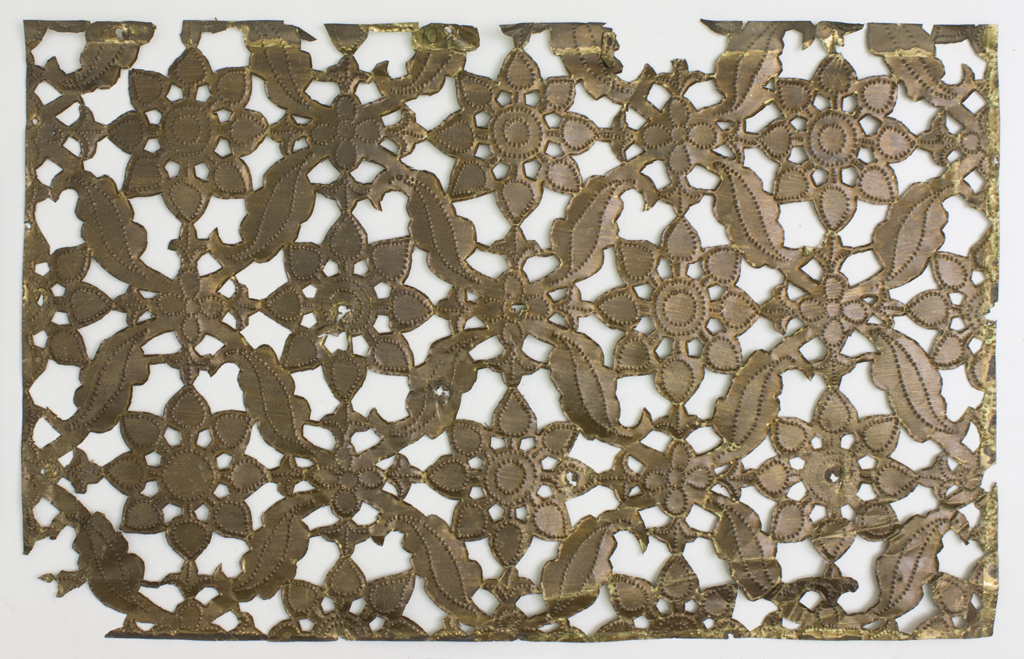
This is a sample visual analysis of the Lockwood de Forest/Ahmedabad Wood Carving Company stencil that adorns our Moodle page and our syllabus. The expectation for the paper is 2-3 pages, so this example is a bit longer than is required. For the genealogy of the ornament section, I realize (even more after writing it!) that this part is challenging. In general, feel free to be in touch with questions.
-
-
593.8 KB · Uploaded 08/26/26, 14:08
-
Look in particular on p. 161 for a reference to our course's topic
8.1 MB · Uploaded 09/7/26, 13:01
-
-
Opened: Tuesday, September 1, 2026, 12:00 AMDue: Sunday, September 20, 2026, 5:00 PM
What associations with the idea of “ornament” did you start the readings with?
What do we learn about the place of ornament in histories of art from this cluster of texts? What were some arguments or claims that surprised or intrigued you?
How might you characterize the conversation that is occurring between these readings? Many of the authors for this week are historians of Islamic art – how do they characterize the position of ornament in discussions of Islamic art history? How might the authors’ positions and the dates of their publications, contexts of production, and intended audiences have shaped these various accounts of ornament?
-
Students mustMark as done
This is a dense reading - try to trace and highlight the author's comments about the scholars and readings that we are doing for this week (Riegl, Ettinghausen, and Herzfeld) and also read carefully the analysis of Owen Jones's The Grammar of Ornament. Do not worry about the taking note of each scholarly work that is discussed; rather, try to trace the broader argument about how scholarship on the "arabesque" has developed and changed over time.
-
708.4 KB · Uploaded 08/27/26, 14:57
-
Students mustMark as done
Focus in particular on the motivation for this argument (p. 234) and on the description of the "infinite rapport" (pp. 272-281).
-
Students mustMark as done
-
5.7 MB · Uploaded 08/28/26, 11:22
-
Students mustMark as done
Further reading
-
-
-
Due: Sunday, October 4, 2026, 11:59 PM
Ann Anlin Cheng writes in Ornamentalism that "uselessness...opens up the 'gap' in the 'symbolic universe of utilitarianism'" (103). In this response, please consider the following questions (in no more than 3 paragraphs):
- What are some instances that we have seen when ornament can be "useful"?
- Drawing upon the readings from this week, please consider to what ends the "uselessness" of ornament be put, instrumentalized, or used to open up "a gap"?
- How might this course on Ornament be useful to your own studies? What ideas have you started to think about for your final paper?
-
-
Students mustMark as done1.3 MB · Uploaded 08/26/26, 14:08
-
Students mustMark as done1.1 MB · Uploaded 08/26/26, 14:08
-
115.2 MB · Uploaded 08/26/26, 14:08
-
-
-
Due: Monday, October 26, 2026, 11:59 AM
Please upload your visual analysis paper here.
- Please upload a Microsoft Word file to enable comments
- Please include your name and the date in the text of the file.
- Please include a small image of the piece that is the subject of your visual analysis
-
Students mustMark as done
The Introduction is an optional reading; we will be concentrating on Chapter 4
-
30.3 MB · Uploaded 08/26/26, 14:08
-
-
Students mustMark as done
This is a sample visual analysis of the Lockwood de Forest/Ahmedabad Wood Carving Company stencil that adorns our Moodle page and our syllabus. The expectation for the paper is 2-3 pages, so this example is a bit longer than is required; the final section of this sample includes a few possibilities for the genealogy of the ornament. If you have already identified a similar ornamental form to your chosen piece, it makes sense to include it in your essay, but it is all right to conclude without this section.
-
-
-
Students mustMark as done
The argument of this essay, as it relates to our course material, first appears on the bottom of p. 103. Consider Farago's claims for the "meanings" that ornament can hold in the context of colonialism and forced conversion: "Otherness is domesticated and familiarized, the grotesque 'idol' is transformed into intriguing exotic decorations, which are at the same time objects of ridicule..." (p. 115-116)
-
Students mustMark as done
This reading, while very important to the theorization of tattooing, can be read as supplementary reading if you wish to pursue this topic beyond the Fleming article. I have highlighted what I perceive to be the most relevant pages.
-
November 2: Universalizing Ornament in the Nineteenth Century: Owen Jones and the Grammar of Ornament
-
Students mustMark as done
**Focus reading on pp. 22-30**
-
Students mustMark as done
Joanna Waghorne reading is the introduction to her book that focuses on the small, southern Indian court of Pudukkottai. Please focus particularly on the Conclusion, where Waghorne lays out an "Ontology of Ornament."
-
Students mustMark as done
I am including this reading for this week in case it is of interest - although it deals with the 17th and 18th centuries, I wondered if it might be helpful to discuss the process of writing a paper that engages with what can seem like purely ornamental designs.
6.6 MB · Uploaded 08/26/26, 14:08
-
-
Week 8: No Class Meeting November 9 - See Below for the Listening Activity to Complete During Class Time
-
For this class time, we will be listening to a piece by the contemporary composer, George Lewis, entitled "The Will to Adorn." Lewis is one of the most important living composers. He specializes in experimental and computer music and invented a music composition platform called Voyager that has revolutionized computer music. He currently teaches at Columbia University. He was also a founder of the Black avant-garde music collective, the Association for the Advancement of Creative Musicians. Lewis adopted the title for the piece from a 1934 essay by Zora Neale Hurston. In his notes for the CD of "The Will to Adorn," Lewis notes that he was responding to Hurston's idea of adornment as a way to think about Black expressivity. He writes: "What I'm interested in is adornment as a compositional attitude or method – for example, Hurston’s notion of 'decorating a decoration,' which is a recursive move."
For our class-time listening activity:
- Begin by reading background on George Lewis and "The Will to Adorn."
- Listen for the first time to "The Will to Adorn." Have a piece of paper or document open. Jot down the adjectives that come to mind as you listen. If you can, try to draw what you hear.
- Listen to "The Will to Adorn" for a second time.
- This time, try to pay attention to the moments when the ornament builds and becomes layered - ornamenting the ornament - in the "recursive" mode that Lewis described. Using the Bandcamp recording, note down the time (minutes: seconds) when the ornament is particularly layered.
- In other discussions of "The Will to Adorn," Lewis has written that this piece also “valorizes instability, and even breakdown.” As you listen for the second time (or third), note down the times (minute:second) when the ornament seems to become unstable or breaks down. Listening again to these sections, try to also come up with words or visual representations for what you hear.
- Upload your Word document or a photo of your hand-written notes to Moodle.
-
Use this link to listen to George Lewis's "The Will to Adorn"
-
This article provides background on the work of George Lewis
3.5 MB · Uploaded 08/26/26, 14:08 -
Opens: Friday, October 23, 2026, 12:00 AMDue: Monday, November 9, 2026, 11:59 PM
-
This chapter is from Cheryl Wall's "On Freedom and the Will to Adorn." Though not required for the in-class listening activity, this chapter discusses Zora Neale Hurston's idea of the "the will to adorn" more extensively.
1.1 MB · Uploaded 08/26/26, 14:08 -
Definitely not required reading for the listening exercise, but interesting to browse through to see the author's discussion of texture and time and also to see annotations from the piece.
24.4 MB · Uploaded 08/26/26, 14:08
-
-
For this week, please focus your reading on Debora Silverman, "Art Nouveau and the Art of Darkness" Part I. Please note that Silverman's "Art Nouveau, The Art of Darkness" Part II is recommended but not required.
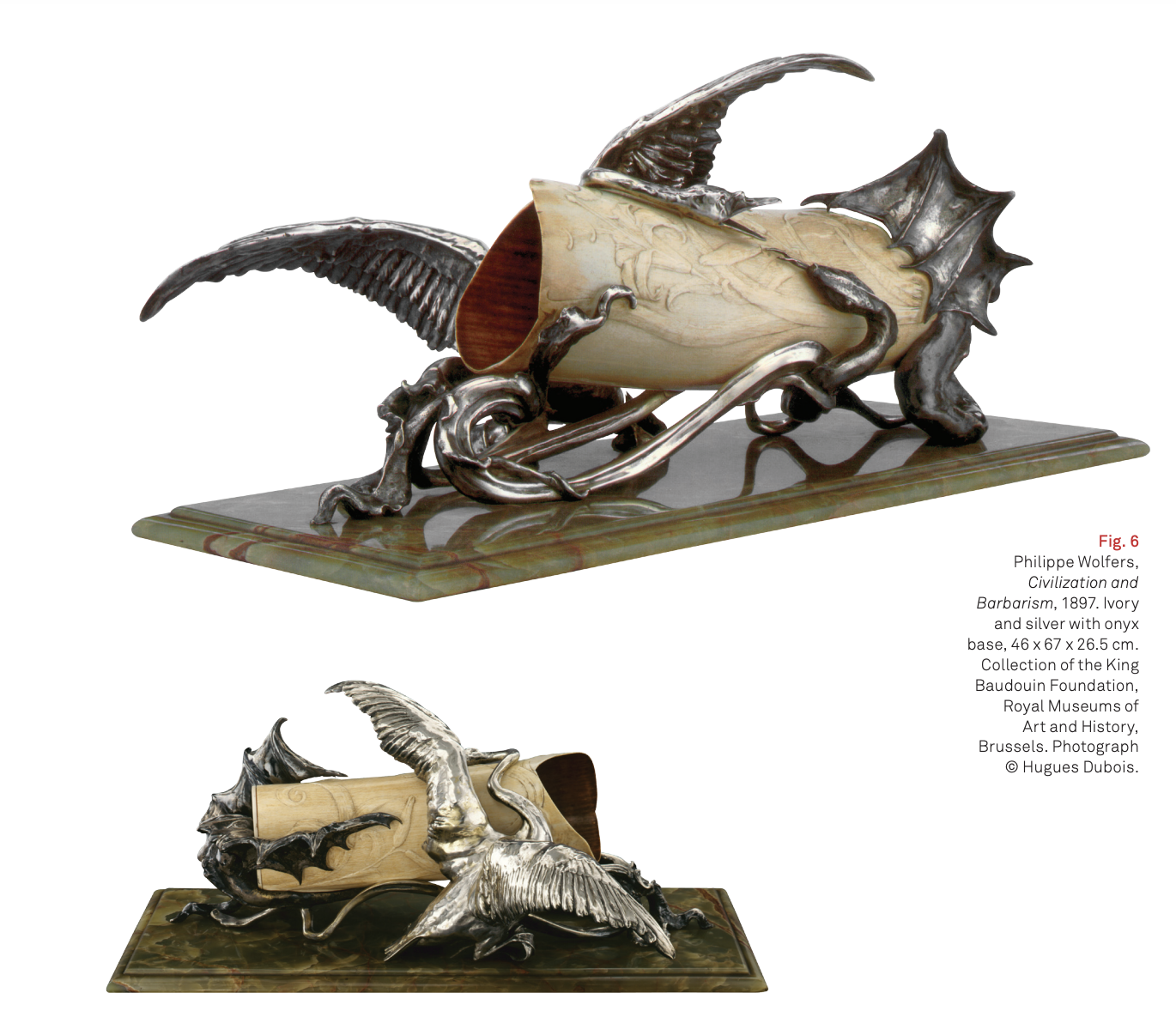
We will be discussing ways to write a revised museum label for this object (above) during our class time.
-
Students mustMark as done
This reading contains graphic descriptions and images of colonial violence in the Belgian Congo.
-
-
-
-
Students mustMark as done
Recommended not required: Schafter, Debra, “Function, Fiction, Flux, and Silence: Ornamental Theory, Science, and the Modern Search for Aesthetic Volition” AND Christiane Hertel “August Schmarsow’s Theory of Ornament” in Loretta Vandi, ed. Ornament and European Modernism (New York: Routledge, 2018).
-